Yes, acrylic foam tape such as 3M VHB can replace screws, rivets and spot welds when the joint works mainly in shear or tension, on compatible surfaces. It is sized to the load: 3M recommends about 55 cm² of tape per kilogram of static load (about 4 square inches per pound), and the bond only reaches full strength after 72 hours. ATE die-cuts these tapes to the shape of the joint as a 3M Preferred Converter.
Acrylic foam tape vs standard double-sided tape
Acrylic foam tape is a double-sided tape in which both the foam core and the adhesive are acrylic. It is designed to replace a mechanical fastener in a product made in series, and is often called structural double-sided tape or simply VHB tape. Mounting tapes sold to consumers as “the strongest double-sided tape” belong to a different family.
The tesa PRO 66792, which tesa presents as its strongest double-sided mounting tape, is a typical example: a polyethylene foam, a synthetic rubber adhesive and a stated hold of 10 kg per 10 cm of tape. It is meant for fixing a nameplate or a key box to a wall. The data sheet for 3M VHB GPH-110GF, by contrast, presents the tape as an alternative to rivets, welds, screws and liquid adhesives.
| Criterion | tesa PRO 66792 | 3M VHB GPH-110GF |
|---|---|---|
| Foam | Polyethylene | Closed-cell acrylic, 710 kg/m³ |
| Adhesive | Synthetic rubber | Acrylic |
| Thickness | 1.15 mm | 1.1 mm |
| Stated strength | 10 kg per 10 cm of tape | Normal tensile 670 kPa (95 psi), dynamic overlap shear 730 kPa (105 psi), ASTM D897 and D1002, after 72 h |
| Temperature | Not stated | 150 °C (300 °F) for days or weeks, 230 °C (450 °F) for minutes or hours |
| Intended use | Indoor and outdoor mounting, nameplates, decorative items | Replacing rivets, welds and screws, including before painting |
The two data sheets do not measure the same thing. “Strongest” only means something with the same test method on the same substrate. For an industrial assembly, the useful questions are how much tape to apply, and on what surface.
The rules quoted here come from the 3M VHB Tape Design Guide, the 3M VHB product information guide and the data sheets linked in the text. ATE uses 3M as the reference because we convert its VHB tapes as a 3M Preferred Converter. Other manufacturers make acrylic foam tapes with their own rules. VHB is a 3M trademark.
Can VHB tape replace screws and rivets?
Yes, provided the joint works mainly in shear or tension and the tape area is sized for the load. A screw or rivet concentrates the load at a few points. Tape spreads it along the whole length of the joint, which, according to the 3M Design Guide, allows thinner, lighter materials.
The same guide lists further effects: no drilling or welding to rework, a joint that seals against the environment and damps vibration, and the ability to bond two different metals without corrosion between them. On the visible face, the fastener disappears.
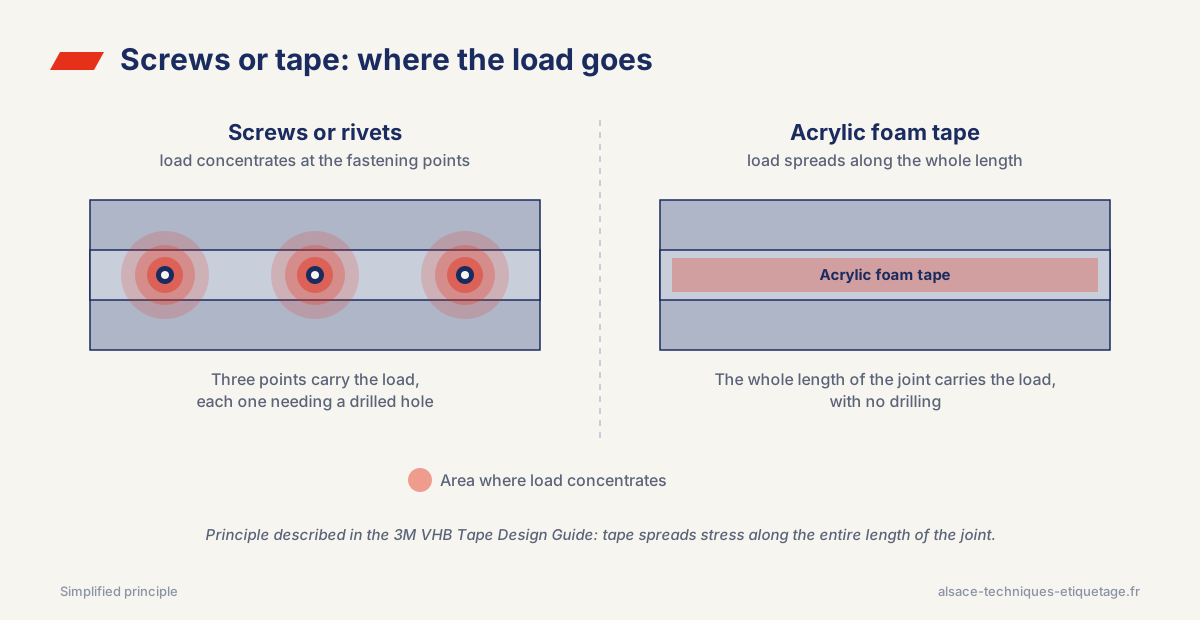
| Criterion | Screws or rivets | Liquid adhesive | Acrylic foam tape |
|---|---|---|---|
| Load distribution | Concentrated at fastening points | Over the bonded area | Along the whole length of the joint |
| Drilling | Yes | No | No |
| Handling strength | Immediate | After curing | On contact, about 50% of ultimate strength after 20 minutes, 100% after 72 hours |
| Shape | Standard | Dispensed bead or film | Part die-cut to the shape of the joint |
The guide also notes the trade-off: a taped joint is more flexible than a screwed one. An application that needs high stiffness may require a design change, such as a stiffener.
When to keep a mechanical fastener
Tape needs test validation, or a backup fastener, in several situations.
- A permanent load that is undersized. Under constant weight, a viscoelastic foam creeps. 3M sets a minimum tape area per kilogram to limit that creep.
- A low surface energy substrate. 3M flags polypropylene, polyethylene and EPDM as hard to bond. They need a tape formulated for these surfaces, or a primer.
- A temperature outside the range (details below).
- A load that lifts an edge. 3M’s sizing rules cover shear and tension. A panel that can be pulled off by one corner works in peel, outside those rules, and has to be validated by testing.
- Application in poor conditions, on a cold or dirty site for example. The bond depends on surface preparation and application temperature.
How much VHB tape do you need per kg or per pound?
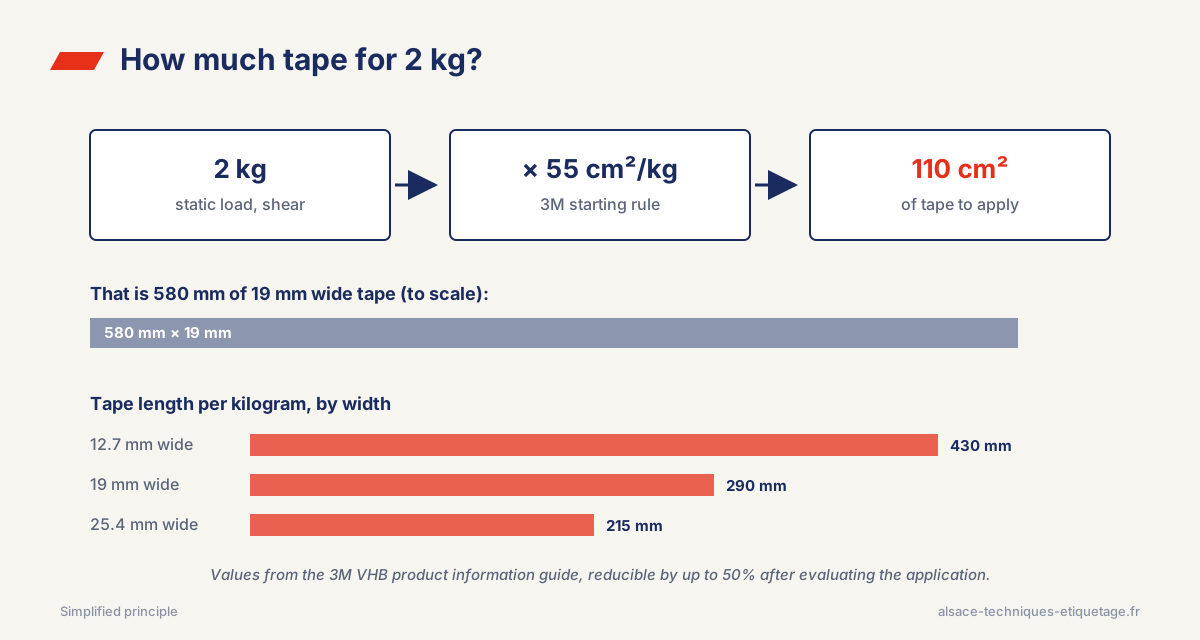
For a static shear load, the 3M product guide recommends about 55 cm² of tape per kilogram. 3M’s US data sheets express the same rule as about 4 square inches per pound. For dynamic loads, the GPH-110GF data sheet gives a design factor of 85 kPa (12 psi), which is 8.5 N per cm² of tape. These are starting points, to be confirmed by testing on the real application.
Static load: a worked example
The guide converts the rule into tape length per kilogram: 430 mm at 12.7 mm (1/2 in) wide, 290 mm at 19 mm (3/4 in), 215 mm at 25.4 mm (1 in). A 2 kg panel hanging in shear therefore needs about 110 cm² of tape, which is 580 mm of 19 mm wide tape. 3M states that this amount can be reduced by up to 50% after evaluating the application.
Dynamic load: the formula
With the 85 kPa design factor, the tape area is simple to work out: area in cm² = dynamic load in newtons ÷ 8.5. A 200 N load therefore needs about 23.5 cm² of tape, or about 124 mm of 19 mm wide tape.
What tape thickness should you choose?
Thickness depends on the gap between the two surfaces and on movement in the joint, not on the load. The 3M product guide gives three rules.
| Situation | 3M rule |
|---|---|
| Flatness mismatch between the two parts | Tape at least twice as thick as the mismatch |
| Bonding sheet metal | Sheet no more than twice the tape thickness: 1.1 mm tape suits sheet up to 2.2 mm |
| Thermal expansion or movement in the joint | Movement limited to three times the tape thickness |
The expansion rule matters as soon as you bond two different materials, aluminum to polycarbonate for example. If the difference in expansion between the two parts exceeds three times the tape thickness, you need a thicker tape or a shorter joint. VHB families range from 0.5 to 3.0 mm thick according to the product guide.
Which VHB tape for which surface?
The choice starts with the surfaces to bond. According to 3M, all VHB families bond well to most metals, glass and high surface energy plastics. The families differ in foam and adhesive firmness, and in the difficult surfaces they handle.
| Family | Thicknesses | Use stated by 3M |
|---|---|---|
| 4930, 4950, 4959 | 0.64 to 3.0 mm | Metals under high dynamic stress |
| 5925, 5952, 5962 | 0.64 to 1.55 mm | The widest variety of surfaces, including most powder coatings and plastics |
| 4936, 4941, 4991 | 0.64 to 2.3 mm | A wide range of materials, including plasticized vinyl (4941 and 4991) |
| 4905 to 4918 | 0.5 to 2.0 mm | High surface energy materials where a clear adhesive is needed |
| LSE | 0.6 to 1.6 mm | Low surface energy materials, without primer |
| GPH | 0.6 to 1.6 mm | High temperature, bonding before powder coating or liquid painting |
Three cases call for a specific family. On polypropylene or polyethylene, use the LSE family, or Primer 94, which 3M says may improve performance on these surfaces. On powder coating, 3M gives the 5952 family for most powder coats, and the GPH family lets you bond before the part goes through painting. For a bond seen through a clear face, the 4905 to 4918 family is the only clear one in this table. Our article on corona treatment explains what surface energy is.
What temperature can VHB tape withstand?
According to the 3M product guide, VHB foam keeps its elastic properties between -40 °C and 90 °C (-40 °F to 194 °F) for the general families. Beyond that, the GPH family is rated for 150 °C (300 °F) for days or weeks and 230 °C (450 °F) for minutes or hours. Its data sheet also states that a 0.5 square inch sample holds 500 g for 10,000 minutes at 177 °C (350 °F).
Cold is mainly an application issue rather than a service one: 3M states that a properly applied tape generally holds well down to -40 °C.
How to apply VHB tape
A correctly sized tape can still fail if it is badly applied. The 3M data sheets give this procedure.
- Clean with a 50/50 mix of isopropyl alcohol and water, after a degreaser if the surface is oily. Scuff paints and hard plastics.
- Check the temperature: ideally 21 to 38 °C (70 to 100 °F), at least 10 °C (50 °F) for most families (0 to 15 °C depending on the family).
- Apply pressure of about 100 kPa (15 psi) on the tape, two to three times more on rigid parts, with a roller or a platen.
- Wait before loading: about 50% of ultimate strength after 20 minutes, 90% after 24 hours, 100% after 72 hours at room temperature. The joint should not be stressed before 72 hours.
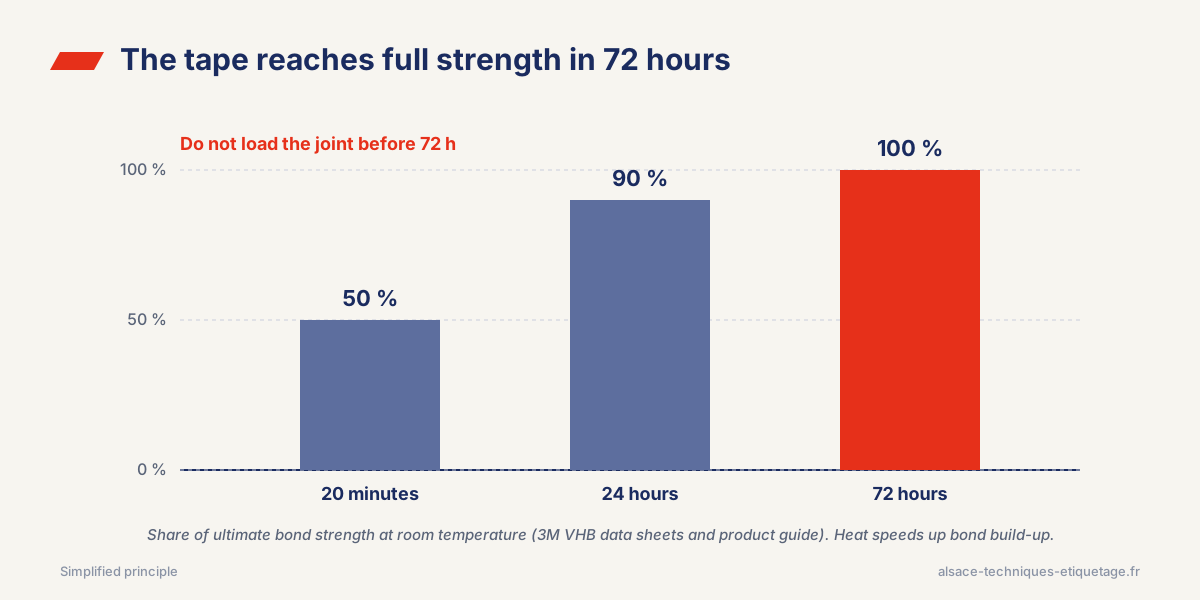
Those 72 hours matter for production planning: a part tested at the end of the line has not yet reached its final strength. 3M states that one hour at 66 °C (150 °F) speeds up bond build-up.
Why a die-cut part rather than a roll?
Because it puts exactly the calculated area in the planned place, with the same shape across the whole run. From a roll, tape is cut by hand and placed by eye, and the bonded area varies from part to part.
ATE die-cuts 3M VHB tapes and supplies them as kiss-cut rolls, sheets or parts on a carrier tape for automated application. The shape is drawn to cover the calculated area without spilling onto a visible face. A pull tab lets the operator remove the liner without touching the adhesive. For robotic placement, the liner and winding direction are set in the specification (see our article on choosing a release liner for automated application).
In series production, rotary die cutting holds a tenth of a millimeter on stable materials, with tools we make in-house. Our article on robotic placement of die-cut parts covers what to define for a robot, and our double-sided adhesives page lists the other 3M families we convert. We produce under IATF 16949 certification.
What to send us for a quote
- The two materials to bond, with their finish: bare metal, powder coating, plastic, glass.
- The load: part weight, dynamic forces, direction of the force.
- Flatness and gap between the two surfaces, to choose the thickness.
- The environment: temperature range, humidity, UV, chemicals.
- Application: manual or automated, workshop temperature, time before loading.
- Volume and the delivery format you need.
Frequently asked questions
What is the strongest double-sided tape?
There is no single answer: strength depends on the substrate, the type of load and the test method. To replace a mechanical fastener in an industrial product, engineers use acrylic foam tapes such as 3M VHB, sized to the load.
Can VHB tape replace screws and rivets?
Yes, when the joint works in shear or tension, the surfaces are compatible and the tape area is sized for the load. 3M presents its VHB tapes as an alternative to rivets, screws and welds. Peel loads and heavy permanent loads need test validation.
How much VHB tape do I need per pound?
For a static shear load, 3M recommends about 4 square inches of tape per pound, or about 55 cm² per kilogram. That is 290 mm of 19 mm wide tape per kilogram. The amount can be reduced by up to 50% after evaluating the real application.
How long does VHB tape take to reach full strength?
According to 3M, about 50% of ultimate strength after 20 minutes, 90% after 24 hours and 100% after 72 hours at room temperature. The joint should not be loaded before 72 hours.
Does VHB tape stick to polypropylene?
Polypropylene is a low surface energy plastic and is hard to bond. 3M offers an LSE family that bonds without primer, or Primer 94 with the other families.
What VHB tape thickness should I use?
According to 3M, the tape should be at least twice as thick as the flatness mismatch between the parts, and movement in the joint should not exceed three times its thickness. For sheet metal, the tape should be at least half the sheet thickness.
Is VHB tape heat resistant?
The general families keep their elastic properties between -40 °C and 90 °C (-40 °F to 194 °F). 3M rates the GPH family for 150 °C (300 °F) for days or weeks and 230 °C (450 °F) for minutes or hours.