An adhesive that won’t hold, ink that wipes off, a coating that peels at the first thermal shock: in the vast majority of cases, the problem lies neither with the adhesive nor the ink, but with the surface itself. Specific plastics, technical films and composite substrates are inherently repellent : nothing bonds to them for long. Corona treatment is the most widely used industrial solution to this problem, and it’s a process we master at ATE.
This article explains what corona treatment is, how it works, which materials and sectors it applies to, and why integrating it upstream of die-cutting or lamination transforms the reliability of a technical part.
What is corona treatment?
Corona treatment is a surface-modification process that raises a material’s surface energy so it becomes receptive to adhesion. In practice, the surface is exposed to a high-voltage electrical discharge : a “corona discharge,” hence the name, which alters its surface chemistry.
Many polymer materials — polypropylene, polyethylene, some PET or fluorinated films — have a surface energy too low for an adhesive, ink or varnish to grip properly. Their surface is described as “non-polar”: liquids bead up instead of spreading out. Corona treatment creates polar chemical groups (oxygen-bearing functions) at the surface, enabling genuine bonding.
The result is measurable: surface energy, expressed in dynes/cm (mN/m), typically rises from a value that is too low to a level sufficient to guarantee durable adhesion. It’s a concrete control criterion, verifiable with test inks or a measuring device.
How it actually works
The material runs between a high-voltage electrode and a conductive roller. The potential difference ionizes the surrounding air and generates a cold plasma — the visible, crackling corona discharge. As it passes, activated oxygen molecules react with the polymer surface.
Three effects combine:
- Surface oxidation : polar chemical functions (carbonyls, hydroxyls, carboxyls) appear and increase wettability.
- Cleaning : the surface is stripped of residual contaminants and release agents.
- Micro-etching : slight micro-roughness increases the available contact area.
The process is dry, solvent-free, fast and can be integrated inline.
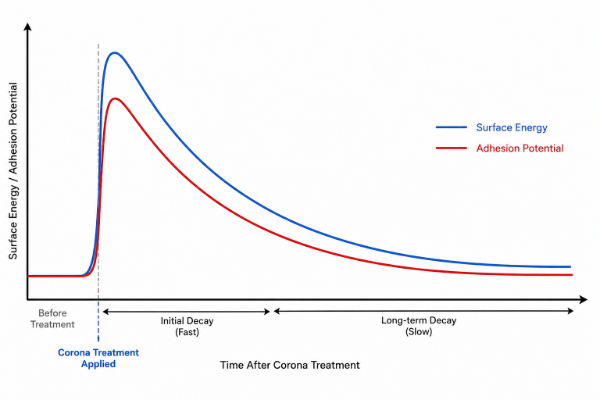
One important point: the effect is not permanent. Surface energy decreases gradually over time (an ageing effect). Treatment must therefore be carried out within a controlled window before the bonding operation — which is exactly why it makes sense to integrate it at the converter, as close as possible to the transformation step.
Which materials and which sectors
Corona treatment is especially useful on low-surface-energy substrates and the technical films we convert every day.
Materials involved:
- Plastics and films : polypropylene (PP), polyethylene (PE), PET films, certain fluorinated and technical films.
- Composite substrates : multilayer complexes where one layer must receive an adhesive or print.
- Adhesive films : carriers intended for lamination, bonding or high-durability printing.
Application sectors:
- Automotive : reliable bonding of die-cut parts subject to vibration and thermal variation.
- Electronics : adhesion on dielectric and insulating films for component assembly.
- Medical : durable markings and adhesives on devices and technical packaging.
- Aerospace and energy : lasting bonds on lightweight substrates and technical films.
At ATE, we work across all these sectors and more. Discover all the sectors we work with.
One example speaks for itself. An automotive supplier needed to attach a polypropylene protective film to an under-hood part exposed to engine heat and constant vibration. Despite a high-performance adhesive, the film peeled at the edges after a few thermal cycles: the untreated polypropylene had a surface energy far too low for a durable bond. By adding corona treatment just before the adhesive was applied, the film’s wettability was raised to the required level, and the bond held through every thermal and mechanical ageing test. No change of adhesive, no added material cost: the obstacle was the surface, not the glue.
Why integrate corona treatment at ATE
Outsourcing surface treatment means adding intermediaries, lengthening lead times and, above all, losing control of the ageing window — with the risk that a treated substrate loses its effectiveness before die-cutting or lamination.
By integrating corona treatment into our converting line, we treat the surface just before the critical operation. Adhesion is controlled end to end, on the same site, with traceability that meets our quality requirements.
This control is part of our positioning as a precision converter: IATF 16949 certification, 3M Preferred Converter status, and a dual industrial footprint in France and Germany serving customers in automotive, electronics, medical, aerospace and energy.
Have a project involving a material that’s hard to bond or print? Let’s talk