A release liner is the siliconized carrier a die-cut adhesive part stays on until it is applied. It holds the part, keeps it in position and releases it at a set force. On an automated line, the liner decides whether the part peels cleanly or the machine stops, before the adhesive is even involved.
Labels and die-cut parts are not the same liner problem
Most of what is written about release liners describes roll labels running on a labeling machine. A die-cut technical part behaves differently. It has no printed content, it is cut to a functional shape, it is often thicker than a label, and it is placed by an applicator or a robot inside an assembly line rather than wrapped onto a container.
That changes what the liner has to do. On a label, the liner mainly has to dispense. On a die-cut part, it also has to hold a geometry, keep a position, survive a cut that deliberately goes into it, and release without deforming a part that has no rigidity of its own.
What a release liner actually is
Two elements make it up. A substrate, paper or film, which provides mechanical strength and caliper. And a silicone coating on the face that touches the adhesive, with a surface energy low enough that the adhesive mass cannot bond to it permanently. That coating is what lets the part separate cleanly, at the intended moment. Without it, the part would stay on its carrier.
The same object goes by several names depending on who you are talking to: liner, release liner, backing, silicone paper, carrier, and support dorsal or papier siliconé in French. In a customer bill of materials it is often filed under packaging, which is where a good share of the trouble starts.
Why the liner is a process component, not packaging
In a specification, the liner almost never appears. The part is defined by its material, its dimensions and its tolerance, and the carrier passes for packaging. As long as application is manual, that holds. As soon as a machine takes over, the carrier becomes a process component, on the same level as the web itself.
Four functions are stacked on that paper or film.
- It holds the part, which has neither rigidity nor flatness of its own.
- It sets the repeat and the orientation in the web. An applicator does not look for the part: it advances by a known pitch.
- The silicone coating sets the release force. Too high, the part deforms before it leaves. Too low, it lifts off on its own inside the roll.
- And it takes the machine path: rollers, peel plate, tension, speed, without breaking or stretching.
Those four functions do not point to the same carrier. This is why the liner has to be chosen at the same time as the application method.
Liner families and what they change
The market revolves around two main families, siliconized paper and polyester film. Coated kraft mostly serves manual use and sheet-fed applications.
| Family | Calipers and grammages | What the manufacturer states |
|---|---|---|
| Siliconized paper (glassine) | 46 to 69 µm depending on grade, i.e. 50 to 80 g/m² (46 µm at 50 g/m², 69 µm at 80 g/m²) | The most common material, at over 70 % of liners. Best carrier for die-cutting small labels and for laser cutting, with translucent properties suited to automatic application. 52 % of paper liners are recycled in Europe. |
| Polyester film (PET) | 23 and 30 µm in rPET with 30 % recycled content, 36 and 50 µm in PET | High strength and moisture resistance. Consistent performance at high speed and registration described as excellent, which points it toward fast dispensing of small labels. 25 % of PET liners are recycled in Europe. |
| Bleached coated kraft | HF55, HF80, HF100 and HF140 grades | Manual dispensing, sheet-fed applications, address and shipping labels, high-speed fanfolding. Low moisture sensitivity. The guide does not present it for automated application of die-cut parts. |
The three columns in this table are taken from the Avery Dennison technical guide to liner materials, Europe, 2021 edition. The values correspond to that manufacturer’s catalogue grades: they give an order of magnitude for the market, not a universal specification.
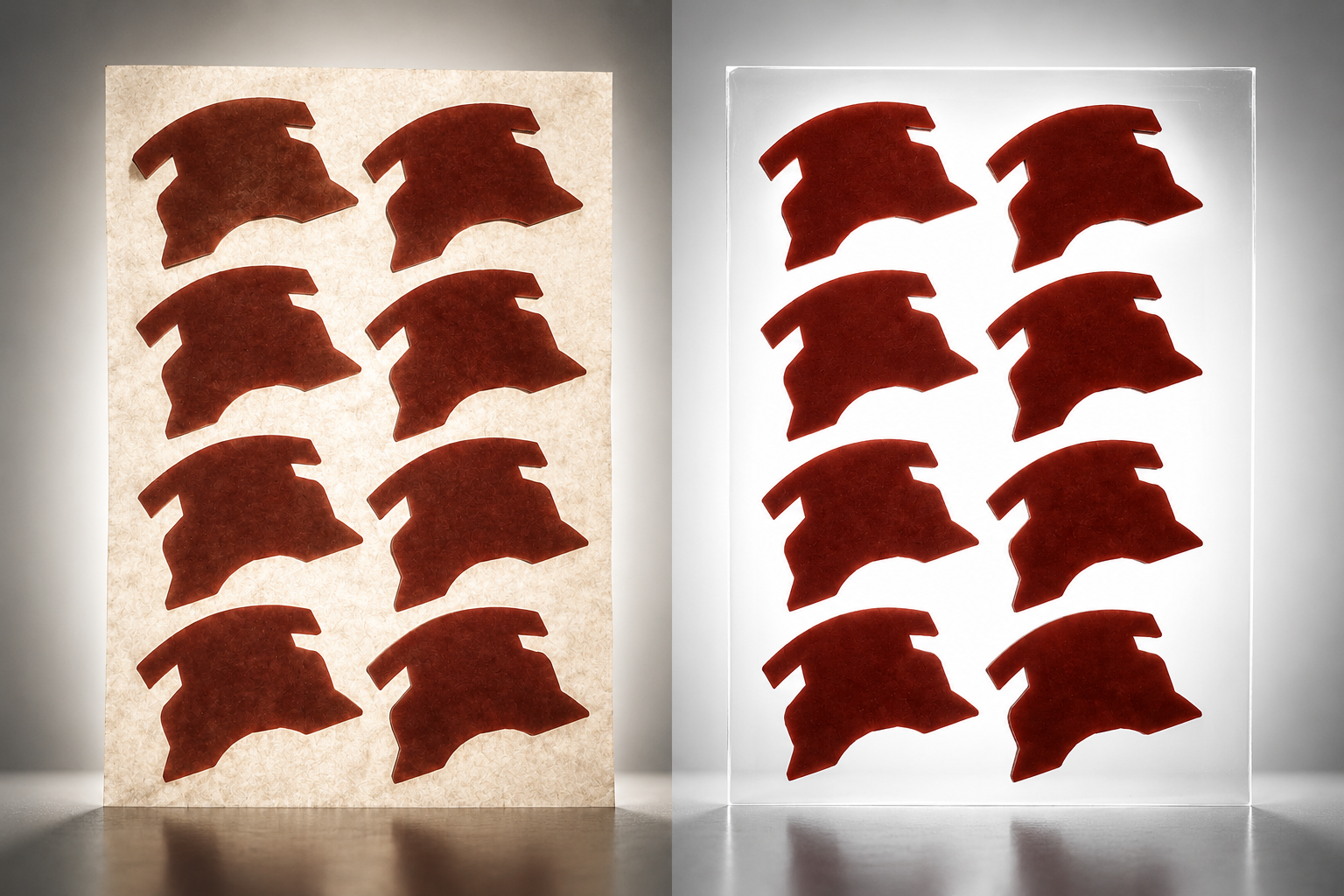
Siliconized paper and polyester film. Same part, two behaviours during dispensing: paper moves with ambient humidity, film holds the repeat better at speed.
At list price, polyester costs more than paper. High line speed, small parts, a plant where relative humidity is not controlled: there the difference is justified. Elsewhere, paper does the job.
Where it fails on the line
The cut went too deep into the carrier
A die-cut adhesive part is usually kiss-cut: the blade goes through the face material and the adhesive, enters the liner, and stops before going through it. Go slightly too deep and you leave a nick the eye cannot see. It gives way during dispensing, under tension, so in production, after inspection has released the roll.
The machine path does not suit the carrier
Every applicator has its own peel plate radius and peel angle. A carrier that behaves well on slow application can break on a fast machine with a tight radius. It can also release the part too late and send it off square. This is why the machine reference belongs in the request for quotation, on the same level as the part drawing.
Repeat and registration have drifted
A machine advances by a pitch. If the carrier has stretched under tension, or has moved with plant humidity, the part is no longer where the machine expects it and placements drift. Measure the repeat at the start and at the end of the roll: the difference points to the carrier, where the reflex is to blame the adhesive.
Nobody planned how to pick the part up
On manual application, the operator has to be able to grip the part without leaving a fingerprint on the adhesive. A finger lift, a back slit in the carrier under the part, an offset cut: three possible answers, and all of them are decided when the tooling is designed. Ask for them at quotation stage rather than after the first delivery.
Five things to tell your converter
A request that says “double-sided tape die-cut to drawing” leaves the choice of carrier to whoever prices the job. These five lines bring the decision back to you.
| What you provide | What it decides |
|---|---|
| The application method manual, semi-automatic or robotic |
The carrier family. A liner that works by hand will not necessarily hold a line speed. |
| The make and model of the applicator | The peel plate radius and peel angle to respect, therefore the caliper and nature of the carrier. |
| Unwind direction and required repeat | Part orientation in the web, tooling design and registration. |
| Plant and storage conditions | The trade-off between a paper and a polyester carrier, if relative humidity is not controlled. |
| Core diameter and permitted roll size | Roll length, therefore the number of roll changes per shift. |
None of this information concerns the part. It concerns the line the part will be applied on, which is why it tends to arrive late, once the part is already approved. On an adhesive assembly application, the carrier belongs in the file as much as the material does.
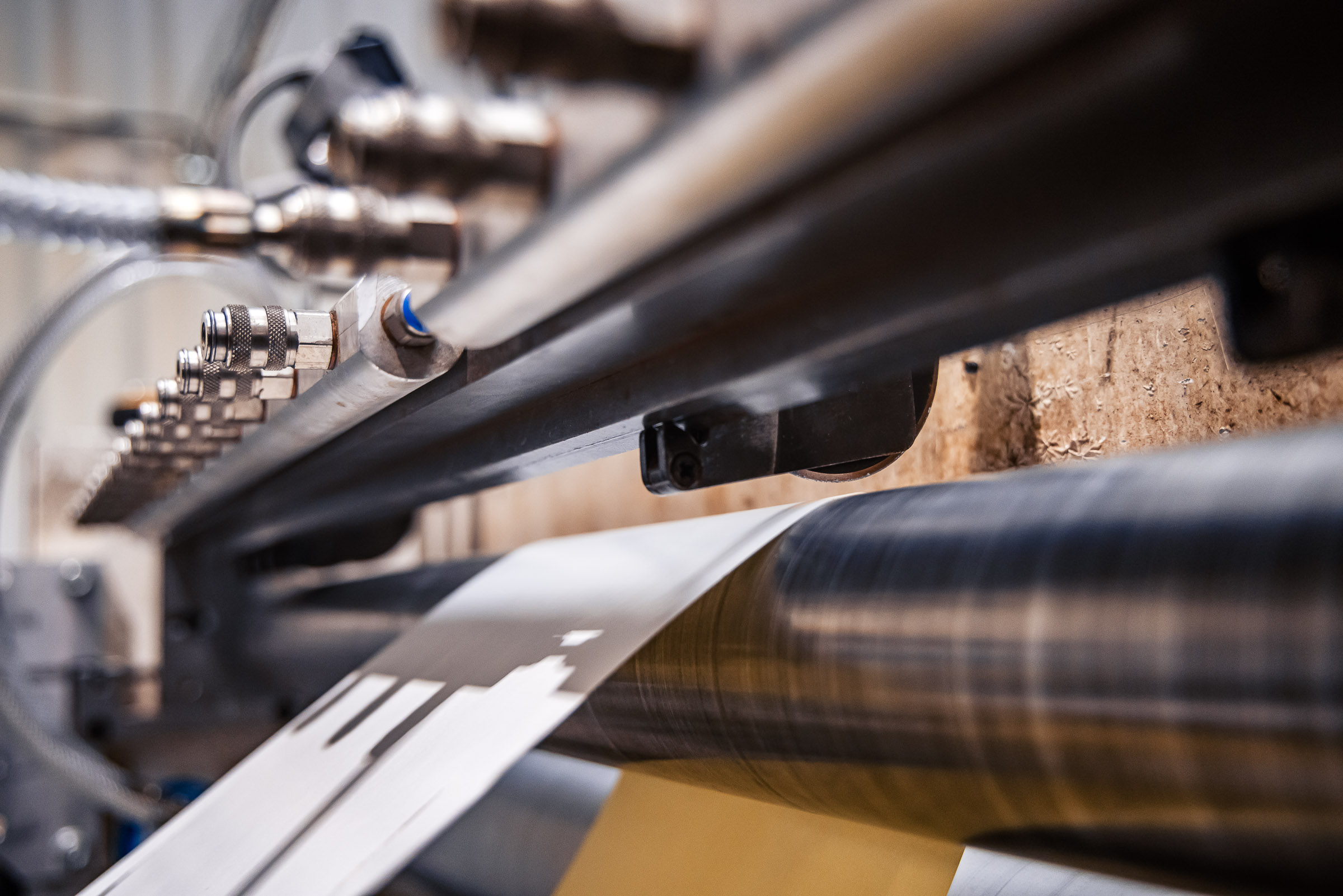
Several parts across the web width. The carrier holds the position of each one between cutting and application, and that position is what the customer’s machine reads.
Liner, linerless, and why die-cut parts are a different question
The word liner is now mostly associated with linerless, those labels without a backing that remove silicone waste altogether. The waste question is real, and paper recycles better than polyester according to the European figures in the guide cited above.
Linerless answers a different problem, though: a printed label applied continuously to a container, with no cut shape. A part die-cut to a functional shape needs a carrier in order to be handled and applied. That carrier is what holds it to its geometry and its pitch between cutting and application. On a technical part, the question is usually which carrier family to use, and what happens to it afterwards.
The distinction also matters when something goes wrong. Look for an adhesion failure on the surface and the material. An application failure sits somewhere along the carrier and the machine path. The two get confused early, when the first hypotheses are formed.
On mobility and automotive programs, where application is frequently automated, the carrier becomes a characteristic of the part and is frozen with it. Depending on the program’s reference standard, changing liner family after approval can fall under change management, with the file that goes with it. Material and carrier are therefore discussed together: precision die-cutting processes and industrial double-sided tapes depend on the carrier that will hold them.
Describe your part and your application line: material, dimensions, application method, machine, unwind direction. Those five items are what it takes to choose a carrier that holds on your line.
Frequently asked questions
What is a release liner?
It is the siliconized carrier an adhesive part stays on until it is applied. It provides strength and flatness, position in the web, and release at a set force. It is also called backing, silicone paper or carrier.
Glassine or PET liner: which one for robotic application?
Siliconized paper covers most machine application and remains the most common carrier on the market. Polyester film is justified at high line speeds, on small parts, and in plants where relative humidity is not controlled: it resists moisture better and holds registration better. The trade-off is made with the applicator reference in hand.
Why does a release liner break during dispensing?
Two causes dominate. A kiss-cut that went too deep into the carrier, leaving a nick invisible to the eye that gives way under tension. Or a carrier too thin for the peel plate radius and the speed of the machine. Examining the back of the web at the break point tells the two apart.
Can a technical part be supplied without a liner?
As a general rule no, not if it is cut to a functional shape. The carrier holds the part to its geometry and its pitch between cutting and application. Linerless solutions target printed labels applied continuously.
Is the release liner recyclable?
Paper liners recycle better than polyester: the 2021 Avery Dennison materials guide reports 52 % of paper liners recycled in Europe against 25 % for PET. If liner waste volume matters to you, it is a criterion to include in the choice of family, alongside application performance.
Do I need a finger lift?
On manual application it stops the operator touching the adhesive to pick the part up. On automated application it is generally unnecessary and can even get in the way. In both cases it is decided together with the tooling design, so at quotation stage.
Can plant humidity shift placements?
A paper carrier moves with ambient humidity, which can change the repeat over a long roll and shift placements. If your plant is not climate controlled, it is worth raising the question when the carrier is chosen.
What should a drawing say about the liner?
At minimum: whether the liner family is imposed or left open, the unwind direction, the required repeat and its tolerance, and whether a finger lift or back slit is needed. If the customer has already qualified a liner on the line, that reference has to be stated.