The European regulation on packaging and packaging waste, known as the PPWR, becomes applicable on 12 August 2026 across all twenty-seven Member States. It replaces Directive 94/62/EC, applies directly without national transposition, and provides no grace period for packaging placed on the market after that date. Your label is a packaging component: it falls within scope.
This text is widely misread, because the date of general application and the deadlines for the major obligations do not coincide. What becomes binding on 12 August is essentially documentary. The heavy requirements, recyclability and recycled content, arrive in 2030. Between the two there are four years to requalify laminates, which is not excessive.
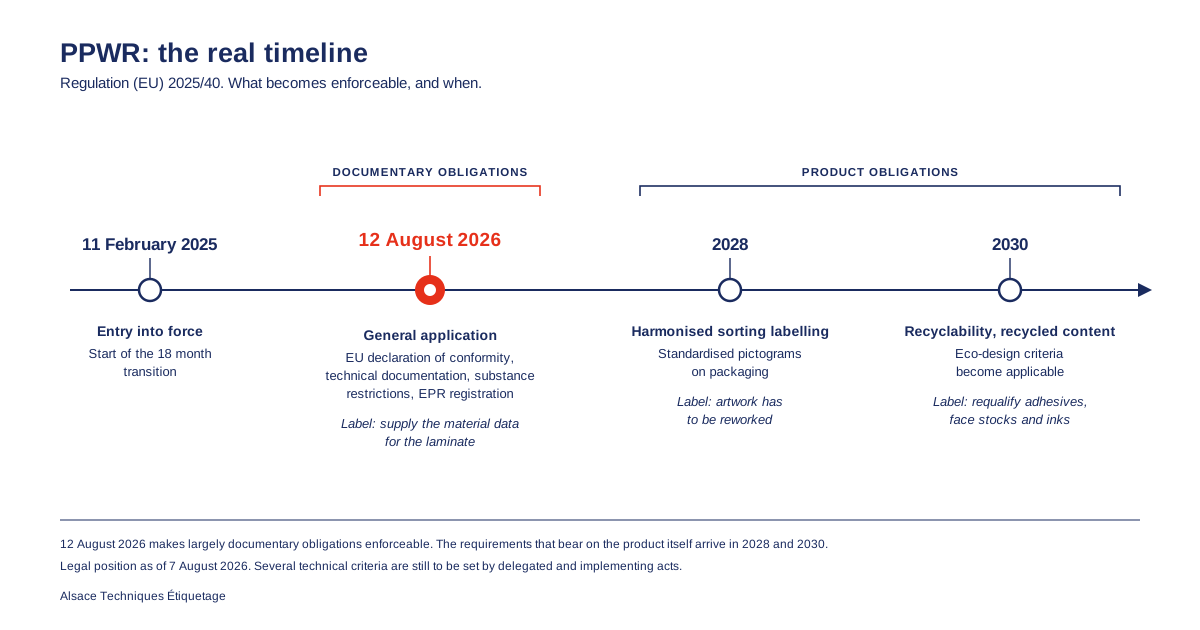
The real PPWR timeline. 12 August 2026 makes largely documentary obligations enforceable. The requirements that bear on the product arrive in 2028 and 2030. Click the timeline to enlarge.
What actually applies on 12 August 2026
Three obligations become enforceable from day one, for any operator placing packaging on the Union market.
The EU declaration of conformity and the technical documentation. Each type of packaging has to undergo a conformity assessment, be covered by a declaration, and be supported by technical documentation kept for several years. That file describes the composition of the packaging, and therefore of its components, label included.
The substance restrictions. The limit on heavy metals applies to the packaging and to its components. For food-contact packaging, the thresholds on PFAS apply as well, the only obligation in the text explicitly restricted to food contact.
Registration under extended producer responsibility in every Member State concerned.
Mandatory recyclability, minimum recycled content, harmonised sorting labelling and format bans, on the other hand, do not apply on 12 August. Those deadlines run from 2028 to 2030. A supplier selling you a “PPWR compliant” label today is selling a shortcut: what exists at this stage is material data feeding your file, not a compliance mark.
| Deadline | What becomes required | What it means for the label |
|---|---|---|
| 12 August 2026 | EU declaration of conformity, technical documentation, substance restrictions, EPR registration | Supply the composition and material data of the label for the packaging file |
| 2028 | Harmonised sorting labelling on packaging | Fit a standardised pictogram into the artwork, so a redesign round |
| 2030 | Recyclability against eco-design criteria, minimum recycled content | Requalify adhesives, face stocks and inks that disrupt sorting or recycling |
Why the label matters when it weighs almost nothing
A label accounts for a fraction of the weight of a pack, and it can still decide what happens to that pack at end of life. Three mechanisms explain the imbalance.
The first is optical sorting. Sorting plants identify resins by infrared spectroscopy. A label covering a large share of the container masks the signal of the material underneath. Some inks heavily loaded with carbon black absorb the radiation instead of reflecting it, and the bottle is then rejected at sorting, whatever the quality of the resin.
The second is contamination of the stream. An adhesive that stays attached to the container through caustic washing ends up in the flakes and degrades the quality of the recycled material. This is exactly what wash-off adhesives address, being designed to release under defined washing conditions.
The third is material compatibility. A label whose face stock belongs to the same polymer family as the container is recycled along with it. A paper label on a PET bottle, by contrast, introduces fibre into a plastic stream.
Substances: the point that concerns you this week
This is the only part of the text calling for immediate action, and it is documentary. If you place packaging on the market, you must be able to demonstrate compliance with the limits, including for the components you buy in. In practice this means asking your label suppliers for material declarations covering heavy metals, and PFAS where the packaging is in contact with food.
The chain of responsibility deserves to be stated plainly: compliance rests with whoever places the packaging on the market, not with their label supplier. The converter’s role is to provide traceable material data that feeds your technical documentation, and to guide the choice of laminate. No converter can issue you a PPWR compliance.
2030 looks distant, requalification does not
Changing a label laminate is not a last-minute decision. Adhesion has to be validated on the real substrate, durability checked under service conditions, application trials rerun on the line, artwork sometimes reworked, and the new laminate then qualified with the end customer. On industrial cycles, eighteen months go quickly.
The work to start first, in increasing order of difficulty:
- List the labels applied to packaging destined for recycling, and separate them from labels applied to technical parts, which are a different subject
- Identify the cases where the face stock is not from the same family as the container
- Spot the artwork with high coverage or deep black on plastic containers
- Assess a move to wash-off adhesive wherever the container enters a recycling loop
- Document the liner stream, which remains waste in its own right
What you should be able to ask your label supplier for
Five items, which any serious converter should provide without difficulty:
- The composition of the laminate, layer by layer, with the material families
- A declaration on heavy metals, and on PFAS for food contact
- The coat weight and thickness, which feed your minimisation justification
- The behaviour of the adhesive under washing, where the container enters a recycling loop
- The type of liner and the take-back streams available
If any one of those five cannot be supplied to you, that is a signal. The technical file for your packaging is built with your suppliers’ data, not in spite of it.
Frequently asked questions
Does the PPWR apply to labels?
The regulation does not address labels separately, but packaging as a whole. A label applied to packaging is a component of it: it enters the conformity assessment, the technical documentation and, from 2030, the recyclability assessment.
What exactly happens on 12 August 2026?
The regulation becomes applicable across the twenty-seven Member States. Enforceable from that day are the EU declaration of conformity together with its technical documentation, the substance restrictions, and registration under extended producer responsibility. The recyclability and recycled content requirements come later.
Can a label be declared PPWR compliant?
Not on its own. Compliance is assessed at packaging level, and it rests with the operator placing that packaging on the market. A label supplier provides material data, not a compliance.
What is a wash-off adhesive?
An adhesive designed to release the label from its container under defined washing conditions, usually hot and alkaline, so that neither the label nor the glue contaminates the recycled material stream. It is one of the technical answers to the recyclability requirements expected in 2030.
Review your labels before 2030
We convert more than 700 material references and we work on laminate selection daily, against our customers’ constraints. Our environmental management system is ISO 14001 certified, which governs how we control our impacts and document our practices, without attesting to the recyclability of any given laminate: that is assessed pack by pack.
If you are building your technical file, or if you need to requalify labels applied to recyclable packaging, send us the list of containers concerned and their end-of-life destination.
Legal position as of 7 August 2026, based on Regulation (EU) 2025/40 published in the Official Journal of the European Union on 22 January 2025. Several technical criteria are still to be set by delegated and implementing acts. This article is general information and does not constitute legal advice.