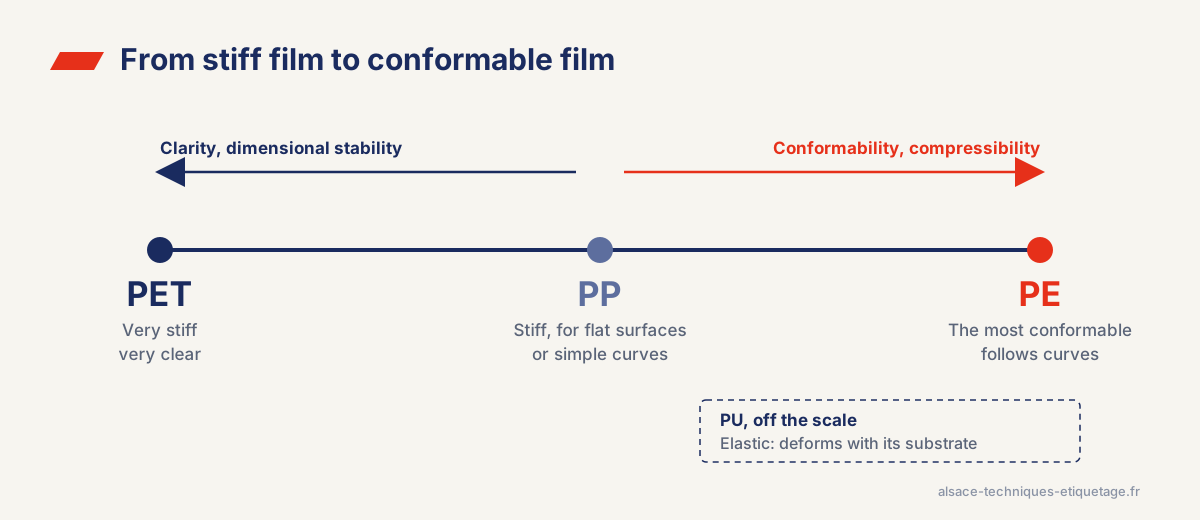
A laminating film is a material bonded to other layers with an adhesive to build a laminate with properties no single layer has. For a technical part, the film is chosen according to the shape of the substrate, the environment, how long the part must stay in place and the look required. A stiff PET suits flat surfaces, while a conformable PE follows curves.
Packaging lamination or technical lamination
The term covers two trades. In flexible packaging, lamination combines plastic films, aluminium or paper to make pouches and multilayer films, for sealing, barrier properties, UV protection or heat sealability. Film maker Granger Group lists food, pharmaceuticals, cosmetics and pet food among the markets for these films.
Our trade is the other one: technical lamination. We bond films, foams, papers or fabrics with an adhesive to make die-cut parts, technical labels and assembly components. If you need a barrier film for food packaging, a packaging film maker will serve you better.
Which laminating film to choose: what each material brings
For plastic films, Avery Dennison’s technical guide to film materials gives a simple scale: going from PET to PE, you gain conformability and compressibility and lose clarity and dimensional stability. The rest of the table relies on the manufacturer documents listed at the end of this article.
| Material | What it brings | What to watch |
|---|---|---|
| PET (polyester) | Very stiff, very clear, dimensionally stable | Low conformability: it will not follow a curved surface |
| PP (polypropylene) | Stiff, available very clear or white | Designed for flat surfaces or simple curves |
| PE (polyethylene) | The most conformable and compressible of the common films | Less clear and less stable than PET |
| PU (polyurethane) | Highly elastic, resistant to abrasion and puncture | Best kept for parts that must deform with their substrate |
| PVC | Flexible thanks to plasticisers, able to follow relief | Plasticisers can migrate into the adhesive |
| Paper and board | A printable base, or a stiffener in the case of board | Paper moves with humidity |
| Foam | Thickness, cushioning, sealing | Compression during application and over time |
| Fabric | The flexibility and strength of a textile | A rough surface the adhesive has to grip well |
| Yupo Tako® | A micro-suction film that holds on flat, smooth surfaces without adhesive, can be repositioned and washed | Only works on smooth surfaces |
Our technical films and technical foams each have their own page.
When PVC needs a closer look
PVC gets its flexibility from plasticisers, liquids built into its formulation. Trade magazine Signs of the Times points out that monomeric plasticisers are more mobile and migrate more readily into neighbouring materials, including the adhesive. Polymeric plasticisers, with longer chains, resist migration better. For a part that has to last, the PVC and the adhesive are therefore chosen together.
The laminating adhesive is chosen with the film
A laminate holds through its adhesive as much as through its films. The first decision is how long the part must stay in place. Avery Dennison separates permanent adhesives, which cannot be removed without damaging the label or the substrate, from removable adhesives, which hold without edge lifting but come off without damage.
Next comes adhesive chemistry. The same Avery Dennison guide gives a few pointers:
- solvent acrylics offer exceptional water, heat and chemical resistance;
- rubber hotmelts give the best low-temperature performance and grip well on apolar, slightly rough or curved surfaces.
On hard-to-bond plastics such as polypropylene or polyethylene, the surface energy of the substrate matters as much as the adhesive. We cover this in our article on corona treatment. To bond two materials together, we often use a double-sided adhesive or a transfer adhesive.
Three examples of technical laminates
A protective film over a print
A technical label exposed to rubbing or cleaning agents gets a clear film over the print. The choice is between the clarity of PET and the flexibility of a more conformable film, depending on the shape of the part. We do this, for example, on some VOID labels.
A foam on a double-sided adhesive
For a gasket, a pad or an assembly part that has to cushion, the foam provides thickness and the double-sided adhesive provides fixing. The laminate is then die-cut to shape and delivered on rolls or sheets.
A repositionable graphic without adhesive
Yupo Tako® holds on smooth surfaces through micro-suction. Printed and die-cut, it gives a marking that can be removed and put back without leaving glue behind.
Questions to ask before choosing
- The substrate. Flat or curved, smooth or rough, and what it is made of.
- The environment. Temperature, humidity, UV, chemicals.
- The duration. Permanent, removable or repositionable.
- The look. Clarity, colour, print.
- The function. Bond, protect, cushion, insulate, inform.
- The application. Manual or automatic: for robotic placement, the laminate also has to stay stiff in the right place.
- The volume. Quantity and order frequency.
Our laminating page describes the process and how we combine these materials.
Torn between several films?
Tell us about the part, its substrate and its environment. We will suggest the right film and adhesive combination, with samples before series production.
Frequently asked questions
What is a laminating film?
A material bonded to other layers with an adhesive to build a laminate. In packaging, these are mostly barrier films. In industry, they are films, foams, papers or fabrics that make up technical parts and labels.
Which film suits a curved surface?
A conformable one. According to Avery Dennison’s technical guide, PE is the most conformable of the common films and PET the stiffest. For a part that also has to deform with its substrate, a highly elastic PU film is another option.
Is PVC suitable for lamination?
Yes, for its flexibility. The PVC and the adhesive should be chosen together, though, because its plasticisers can migrate into the adhesive. Polymeric plasticisers migrate less than monomeric ones.
Which laminating adhesive should I choose?
First decide between permanent and removable. Then pick the chemistry: solvent acrylics for water, heat and chemical resistance, rubber hotmelts for low temperatures and apolar or slightly rough surfaces.
Can a film hold without adhesive?
Yes, on smooth surfaces. Yupo Tako® holds through micro-suction, can be repositioned without leaving glue, and can be rinsed with water once it has lost its grip.
Sources
- Avery Dennison, Film Materials, Labels and Packaging technical guide Europe 2021
- Avery Dennison, Adhesive Technologies, Labels and Packaging technical guide Europe 2020
- Covestro, Platilon® TPU films
- Signs of the Times, Another Look at Calendered Vinyl Film
- Yupo, YUPOTAKO®
- Granger Group, films for lamination