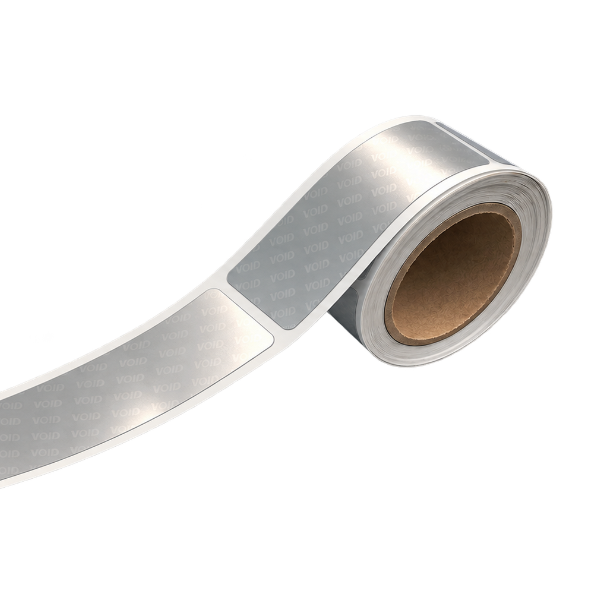
A VOID label is a security label that reveals a message, usually the word VOID, as soon as someone tries to peel it off. Once removed, it cannot be put back without the attempt showing. Depending on how it is built, the message stays on the surface, on the label, or on both.
Discuss your VOID label project
What is a VOID label?
The name comes from void, as in null or invalid. You will also see tamper-evident label, security seal or warranty seal. It proves that a product or its packaging has not been opened since it was sealed.
It won’t stop anyone opening the pack, since a screwdriver or a blade gets through it easily. What it does is leave a mark that sticking the label back down cannot hide.
How it is built
A VOID label looks like a standard pressure-sensitive label, with a few extra layers:
- a face film, usually white, silver or clear polyester, which carries the print
- a release layer printed in a pattern under the film, which forms the message on removal
- a permanent adhesive, whose grip on the surface has to exceed the cohesion of the release layer
- a silicone liner, peeled off at application
For a sense of scale, the datasheet for 3M Tamper-Indicating Label Material 7935 lists a 0.05 mm polyester, a 0.02 mm acrylic adhesive and service temperatures from -40 °C to 121 °C. Other materials have other values, and the datasheet of the material you choose is the one that counts.
How the VOID effect works
Avery Dennison sums up the principle in its bulletin on tamper-evident polyesters: any attempt to lift, remove or reapply the label causes a special coating to release, revealing the word or pattern on both the label and the substrate.
The adhesive holds the surface harder than the release layer holds the film. When you pull, the label splits inside itself, along the printed pattern. Part of it stays on the surface and part leaves with the film.
There is one condition: the adhesive needs time to build up its bond. Both 3M and Avery Dennison state that a permanent bond is normally reached after 72 hours at room temperature. 3M suggests a first check after a 10-minute dwell but bases the final judgement on 72 hours. A label torn off right after application can therefore come away whole, with no message. The material is not at fault: the adhesive simply had not finished building its bond.
One more detail, given by 3M for its 7381 material: the message transferred to the substrate can be removed by hand rubbing or solvent wiping. The label itself stays marked. So when you inspect a seal, check the label as well as the surface.
Total transfer, partial transfer, no residue
VOID labels fall into three families, depending on where the message ends up after removal.
| Family | What you see after removal | Typical use |
|---|---|---|
| Total transfer | The printed layer stays on the surface. The film comes away empty or nearly so | Visible evidence on the product itself, packaging and porous substrates |
| Partial transfer | The message is split between surface and label, each the negative of the other | Warranty seals on housings, equipment, IT hardware |
| No residue | The message shows in the label. The surface stays clean | Products where appearance matters, premium packaging, reused equipment |
The choice comes down to one question: who needs to see the evidence, and where? On an electronic housing returned under warranty, the service team wants to see the mark on the housing. On a cosmetics box, the end customer does not want sticky residue on the product. Securikett positions its residue-free seals for cosmetic jars, luxury boxes and electronic devices, where appearance comes first.
Customising the message and the label
VOID is the standard pattern, though you are not tied to it. Material makers offer other patterns: 3M lists triangle-pattern materials, for example (FMV01402 and FMV01202). On a custom order, the pattern can become a text such as OPENED, or a logo.
The face is printed like any technical label, with a logo, text, colours and variable data. Numbering makes a big difference: once a seal is tied to one product or batch, it cannot be swapped for a blank seal bought elsewhere.
You can add, for example:
- sequential numbering, to trace every seal
- a barcode, QR code or Data Matrix, to link the seal to a database
- a background colour or a warning text
- a hologram, adding an authenticity check to the opening evidence
Which surfaces suit a VOID label
The VOID effect depends entirely on adhesion. If the adhesive grips poorly, the label lifts off in one piece and no message forms. The substrate matters as much as the label.
As an example, 3M lists stainless steel, ABS, polypropylene, painted metal, polyester, HDPE, nylon, glass and polycarbonate for its 7935 material. The same documentation names Teflon as a difficult surface. That matches the surface energy values 3M publishes: PTFE sits at 18.5 mN/m and silicone at 24, too low for a pressure-sensitive adhesive to hold over time.
Before approving a substrate, check:
- how clean it is. 3M recommends cleaning the surface with isopropyl alcohol or heptane before application. A mould release agent or a fingerprint is enough to skew a test.
- how porous it is. Board and paper absorb part of the adhesive. Some constructions are designed for them, others are not.
- its shape. Polyester film is stiff. On a tight curve it tends to lift before the bond has built up.
Avery Dennison ends its bulletin with advice we follow as is: test in the real application before committing to production. We run those tests with you, on your parts.
Applications by sector
Electronics and IT hardware
This is the best-known use. The seal goes over a screw, a housing joint or a cover. If it is broken, the manufacturer knows the device was opened outside its network, which decides the warranty. Partial transfer suits this use well, since the evidence stays on the housing.
Medical and pharmaceutical
In Europe, Delegated Regulation (EU) 2016/161 requires an anti-tampering device on the packs of many prescription medicines, in addition to the unique identifier. A security label is one way to meet it. For this sector we produce in an ISO 7 cleanroom, within our quality system.
Automotive and industry
On a sub-assembly shipped sealed, a VOID label shows at goods-in that nobody has touched it between two sites. It is also used on cabinets, meters and equipment whose settings must not be changed. Combined with a serial number or a Data Matrix, it becomes part of the part’s traceability.
Logistics and transport
Container doors, crates, security envelopes, high-value parcels: a VOID seal lets the receiver check that a shipment was not opened in transit.
Cosmetics, luxury and consumer goods
The seal shows the end customer that the product has never been opened, and it makes refilling genuine packaging harder. Residue-free constructions suit this best, since they leave the pack intact.
VOID, destructible or hologram: how to choose
VOID labels are most often compared with destructible labels and holograms.
| Solution | Principle | What it proves | Limit |
|---|---|---|---|
| VOID label | A message appears on removal | An attempt to open | Needs time to build its bond and a compatible substrate |
| Destructible label | A brittle film, often vinyl, that breaks up when peeled | An attempt to open, since the label cannot come off whole | No readable message |
| Hologram | An optical image that is hard to copy | Product authenticity | On its own, it does not prove opening |
For destructible labels, 3M describes its 7613T material as a white vinyl that fractures to deter removal attempts. A hologram and a VOID effect, on the other hand, can be combined on the same label: the first shows authenticity, the second shows opening.
How we make a VOID label
VOID films come from the material makers. Our work as a converter starts after that: selecting the right film with you, then turning it into a label ready to apply. A material designed to break needs care at every stage. VOID labels are part of our protection solutions, alongside holograms.
Printing
We print in flexo, screen and digital. Flexo handles long multi-colour runs. Digital handles variable data: incremented numbers, barcodes, QR codes and Data Matrix codes, different on every label.
Laminating
Laminating adds a layer over the print, such as a film against abrasion or chemicals, or builds a hologram into the construction.
Cutting
Rotary die cutting kiss-cuts the label to shape without scoring the liner. On a VOID material, this is the most sensitive step. The release layer is designed to give way under stress, and matrix stripping, which removes the waste around the labels, creates stress. So we validate the shape, corner radii and web direction in trials before the series run. We make our own rotary tools, which lets us adjust the tool instead of fitting your label to an existing one.
Winding and application
Labels are delivered on rolls or sheets, depending on whether they are applied by hand or by a labelling machine. For automated application, liner choice and winding direction are set in the specification.
What to define before you order
With these seven answers we can quote accurately, and you avoid a first batch you cannot use.
- The substrate. Material, surface condition, shape. Samples of the real part if possible.
- The VOID family. Total transfer, partial or no residue, depending on where the evidence must stay.
- The message. Standard VOID, custom text or logo.
- Face printing. Colours, logo, text, and any variable data.
- The environment. Temperature, humidity, chemical contact, UV exposure.
- Format and application. Dimensions, manual or automatic application, packaging.
- Volume. Quantity per order and frequency, which steer the choice of printing process.
Have a VOID label project?
Send us the substrate, the format you need and the kind of evidence you expect. We will suggest the right construction and run trials on your parts before the series run.
Frequently asked questions
What is a VOID label?
A security label that reveals a message, usually the word VOID, when someone tries to peel it off. It cannot be reapplied without the attempt showing. It proves that a product or its packaging has not been opened.
What is the difference between total transfer, partial transfer and no residue?
Where the message ends up. With total transfer, the printed layer stays on the surface. With partial transfer, the message is split between surface and label. With no residue, the message shows in the label and the surface stays clean.
Why does a VOID label sometimes come off without leaving a message?
Usually because the adhesive has not had time to build its bond. 3M and Avery Dennison state that a permanent bond is normally reached after 72 hours at room temperature. A dirty or low surface energy substrate, such as PTFE or silicone, has the same effect.
Can a VOID label be customised?
Yes. The message can be replaced by a text or a logo, and the face is printed like a standard label. Digital printing adds numbering, a barcode, a QR code or a Data Matrix code that differs on every label.
What is the difference between a VOID label and a destructible label?
A VOID label reveals a readable message on removal. A destructible label, often vinyl, breaks into pieces and cannot be removed whole. Both prove an attempt to open, with a different result.