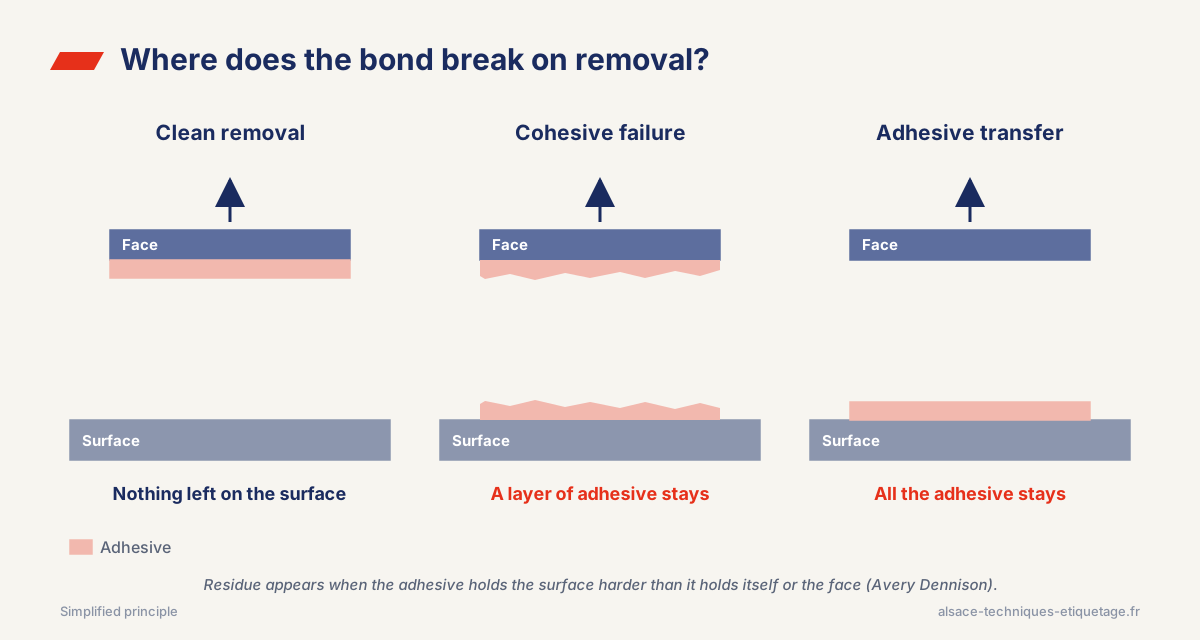
An adhesive leaves residue when it holds the surface harder than it holds itself or its face: on removal, the adhesive splits and part of it stays behind. The risk grows with time, heat and UV, and on smooth surfaces such as glass or stainless steel. It is prevented at the design stage, through the choice of adhesive and construction.
Find the right adhesive for your part
Why does an adhesive leave residue?
On removal, the bond always breaks at the weakest point of the assembly. If that point is the interface between adhesive and surface, the label or film comes off clean. If it is inside the adhesive, the adhesive splits in two and a layer stays on the surface. If it is the interface between adhesive and label face, all the adhesive stays behind: this is called adhesive transfer.
Avery Dennison sums it up in its guide to removable labels: residue appears when the adhesive bonds more strongly to the surface than to itself. It adds that this is common on smooth, high surface energy surfaces such as glass, porcelain and stainless steel.
The opposite problem exists too. Part of the enquiries ATE receives come from labels that fall off because the adhesive was not suited to their environment. Choosing an adhesive is therefore a balance: hold for the planned time, then come off without residue.
Why does adhesive residue appear over time?
A label that peels off cleanly on day one can leave residue when it is removed much later. 3M’s film removal documents put this down to ageing: over time, adhesion to the surface increases and the film becomes brittle. Prolonged exposure to heat, UV and humidity speeds this up.
- Dwell time. A removable adhesive is removable for a given period. The tesa 4848 protective film, for example, is stated to remove without residue within four weeks of application, even after UV exposure outdoors.
- Heat and UV. According to 3M, they raise adhesion and make the film brittle, which makes removal harder.
- Flexible PVC substrates. Plasticizers in PVC can migrate into the adhesive, to the point that manufacturers file patents for adhesives resistant to this migration. 3M, for example, presents its VHB 4941 and 4991 tapes as plasticizer resistant, for plasticized vinyl.
Permanent, removable or ultra removable: which adhesive for which duration?
The first choice is the adhesive category, which sets what you can expect on removal. 3M Instruction Bulletin 6.5 gives an order of magnitude for its graphic films:
| Category | Expected residue | Removal |
|---|---|---|
| Ultra removable | No residue expected | No heat or chemicals |
| Removable with heat | Up to 10% residue in some conditions | With heat |
| Removable with heat and/or chemicals | May exceed 30% | With heat and/or chemicals |
| Not intended for removal (permanent) | Significant residue | Difficult, with a risk of damaging the surface |
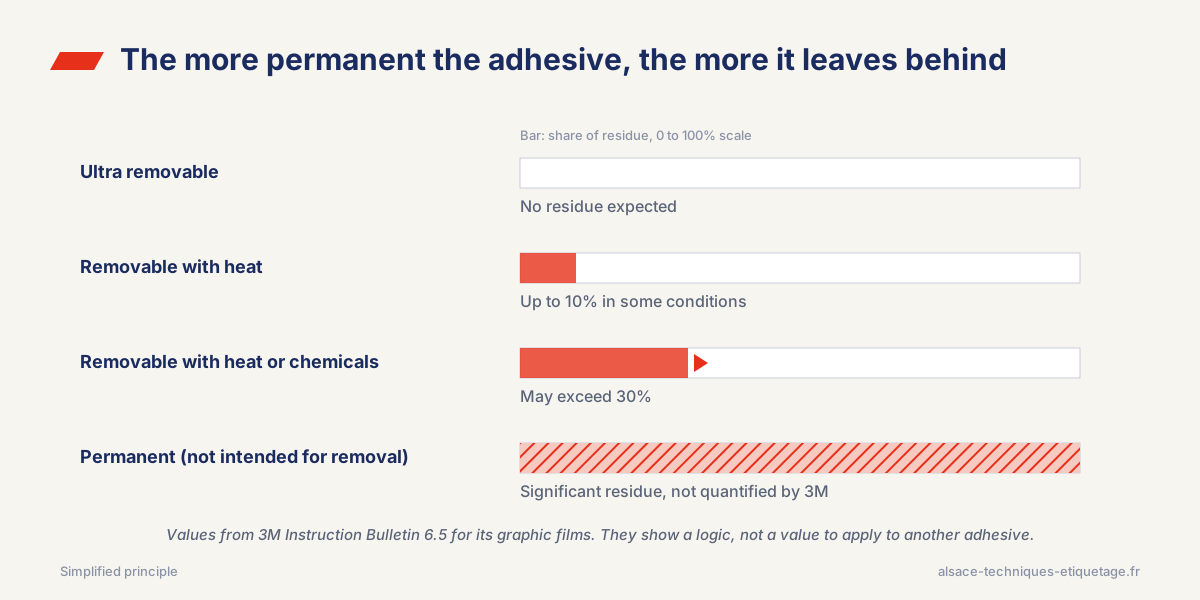
These figures apply to specific 3M films. They show why the adhesive category is chosen for the use. A label designed to last the life of the product is not made to peel off cleanly. If it has to be removed, by the end user, at inspection or after a manufacturing step, say so in the specification.
Avery Dennison points out another frequent mistake: using a permanent adhesive for a label meant to be removable. The removal force then exceeds the strength of the face, and the label tears instead of peeling.
Which surfaces are most prone to adhesive residue?
Smooth, high surface energy surfaces. Avery Dennison names glass, porcelain and stainless steel as the most exposed. 3M notes that a film comes off a low surface energy surface, such as plastics, more easily than glass or bare metal.
Surface condition matters too: 3M points out that oxidized or chalky paint changes adhesion. Our article on corona treatment explains what surface energy is.
How to prevent adhesive residue at the design stage
Residue is prevented before the first application. Six decisions matter.
- Choose the adhesive category for the real dwell time: a few hours of masking, a few weeks of protection, or the life of the product.
- Lower the adhesion if needed. Against residue, Avery Dennison recommends an adhesive with lower peel adhesion, higher anchorage to the face material, or higher cohesive strength.
- Strengthen the face if it tears. Avery Dennison mentions films and reinforced papers, which are stronger than standard paper.
- Describe the environment: temperature, UV, humidity, cleaning products. According to 3M, heat, UV and humidity are what raise adhesion over time.
- Specify the surface: material, finish, paint, condition. The same adhesive can come off a plastic more easily than glass.
- Test on real parts, under real application, storage and removal conditions, before the production run.
For these tests, we produce prototypes by digital cutting, without tooling, so you can test them on your own parts.
How to remove an adhesive without leaving residue
Once a label or film is in place, the removal method limits the damage. 3M’s removal bulletins give these guidelines for adhesive films:
- Work above 10 °C (50 °F). In the cold, the film becomes brittle and breaks into small pieces. The higher the temperature, the better the result.
- Heat the film evenly to 72 to 93 °C (160 to 200 °F) to soften the adhesive. Never on glass, which can break, and with care on sensitive plastics: 3M Bulletin 6.5 limits heating of acrylic or polycarbonate windows to 21 to 38 °C (70 to 100 °F).
- Pull slowly. 3M states that slow removal tears the film less and leaves less residue. The best peel angle depends on the film: 3M advises adjusting it by trial.
- Clean the remaining residue with an adhesive cleaner, tested first on an inconspicuous area: some products damage the surface or its finish.
These steps reduce residue, but they do not turn a permanent adhesive into a removable one. If removal is part of the normal use of the part, the answer lies in the choice of adhesive.
Masking, protective films and removable labels at ATE
ATE converts three families of products designed to be removed:
- polyimide masking (Kapton type, a DuPont trademark), which protects an area during painting, powder coating or oven curing, then comes off;
- protective films, which protect a surface during manufacturing, storage or transport;
- removable labels, peeled off by the user or at a process step.
We die-cut them to the shape of the area to protect or of the label, and we can laminate a removable adhesive with the right face material. These products are part of our protection solutions. With more than 700 raw materials and our 3M Preferred Converter status, we help you choose the adhesive suited to the planned dwell time and removal, to be confirmed by your own tests on real parts.
What to send us
- The function: masking, protection or identification, and who removes the part.
- The dwell time before removal.
- The surface: material, finish, paint.
- The environment while in place: temperature, oven, UV, humidity, cleaning.
- Removal conditions: by hand or by machine, at what temperature.
- Format and volume: rolls, sheets, die-cut parts, quantities.
Frequently asked questions
Why does a label leave adhesive behind when you peel it off?
Because the adhesive holds the surface harder than it holds itself or the label face. On removal, the adhesive splits and part of it stays on the surface. It is common with permanent adhesives, after ageing, or on smooth surfaces such as glass or stainless steel.
What is the difference between a permanent and a removable adhesive?
A permanent adhesive is designed to stay in place for the life of the product and generally leaves residue on removal. A removable adhesive is designed to come off cleanly, but for a given period and under given conditions.
Can a removable adhesive still leave residue?
Yes, if it stays in place longer than planned or is exposed to heat and UV. Adhesion increases over time, according to 3M. A protective film such as tesa 4848, for example, is stated to remove without residue within four weeks.
How do you remove a label without leaving adhesive residue?
According to 3M: work above 10 °C (50 °F), heat the film to 72 to 93 °C (160 to 200 °F), never on glass and much less on acrylic or polycarbonate, pull slowly, then clean what remains with a cleaner tested on an inconspicuous area.
Which surfaces are most prone to adhesive residue?
Smooth, high surface energy surfaces such as glass, porcelain and stainless steel (Avery Dennison). According to 3M, a film comes off low surface energy plastics more easily.
How do you prevent adhesive residue on an industrial part?
By choosing the adhesive for the dwell time, surface and environment, and testing it on real parts before the production run. If the part has to be removed, state it in the specification.