To quote a die-cut adhesive part right the first time, a converter needs a dimensioned drawing (DXF, DWG or PDF), the material or the required function, the application and its environment, the quantities and the delivery format. With this information, ATE issues a standard quote within 2 to 5 working days.
Why your converter asks so many questions
The same shape can be priced very differently depending on the material, the adhesive, the cutting die and the packaging. A 40 × 60 mm gasket will not cost the same in polyethylene as in silicone, supplied loose or on a roll for automated application, at 500 or at 50,000 parts a year.
A converter cannot choose these parameters without knowing the application. Without this context, the quote rests on assumptions, and a major change mid-project can mean a new quote.
What to include in a quote request
| Information | What it changes in the quote | If you don’t have it yet |
|---|---|---|
| 1. Dimensioned drawing (DXF, DWG or PDF) | The shape, the dimensions and therefore the cutting die | No DXF or DWG? A dimensioned PDF is enough |
| 2. Tolerances on critical dimensions | The cutting process and inspection | Mark at least the functional dimensions |
| 3. Material or manufacturer part number | Material cost and availability | Describe the function: we will suggest a material |
| 4. Bonding surface | The choice of adhesive | Name the material (metal, plastic, glass, paint) |
| 5. Environment | The material, the adhesive, sometimes a protective layer | Min and max temperatures, humidity, UV, chemicals |
| 6. Quantities | How the die cost is spread and the price per part | Prototype, first run and estimated annual volume |
| 7. Delivery format | Packaging and liner | Loose, in sheets, on rolls, on a liner strip |
| 8. Application method | The liner, unwind direction and part spacing | Manual or automated application |
| 9. Quality requirements | The documents and inspections to plan for | PPAP, certificate of conformity, lot traceability |
| 10. Schedule | Planning of prototypes and production | Target dates for prototypes and production |
A dimensioned drawing and a description of the application are the starting point; the other details can follow in stages.
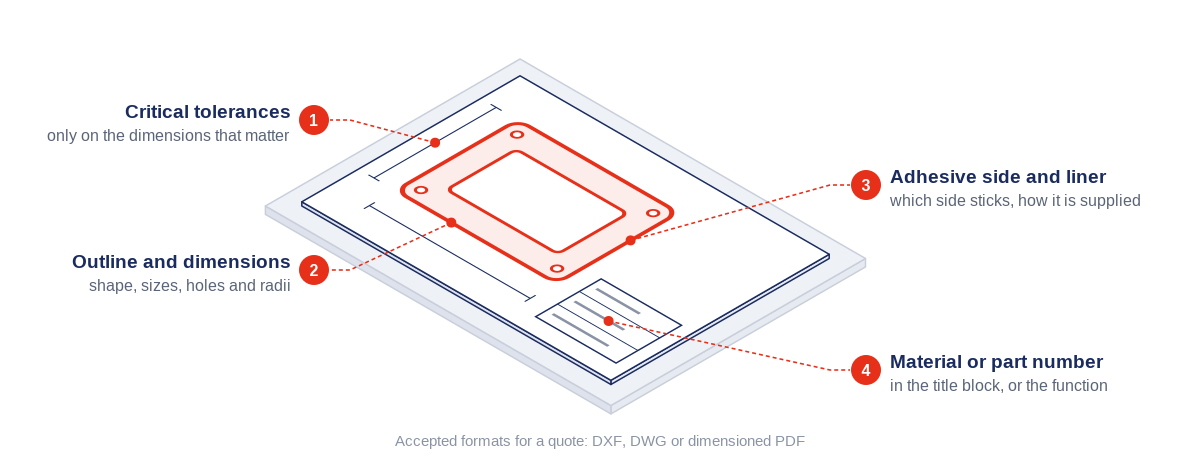
What a drawing should show
- Outline and dimensions: outer shape, internal cut-outs, holes, radii.
- Tolerances, only on the dimensions that matter for assembly. Tight tolerances everywhere make the part harder to produce without making it work better.
- Material or part number, in the title block. Failing that, the part’s function.
- The adhesive side: which side bonds, to what, and whether the part is supplied on a liner.
A screenshot or a photo usually gives neither usable dimensions nor a reliable scale: always start from a DXF or DWG file, or a dimensioned PDF.
Why the price per part drops as quantity rises
A quote adds up two types of cost:
- Fixed costs, which do not depend on quantity: the cutting die and machine setup.
- Variable costs, paid for every part: material and machine time.
The cost per part is therefore: fixed costs ÷ quantity + variable cost per part. As quantity rises, the share of the die and setup in each part falls. Once the die cost is spread, the price depends mainly on material and machine time.
This is why annual volume matters as much as the size of the first order: it means the right process can be chosen from the start. For prototypes, toolless digital cutting avoids the fixed cost of a die. For production, rotary die cutting generally becomes the better option when volumes are high enough to spread the die cost.
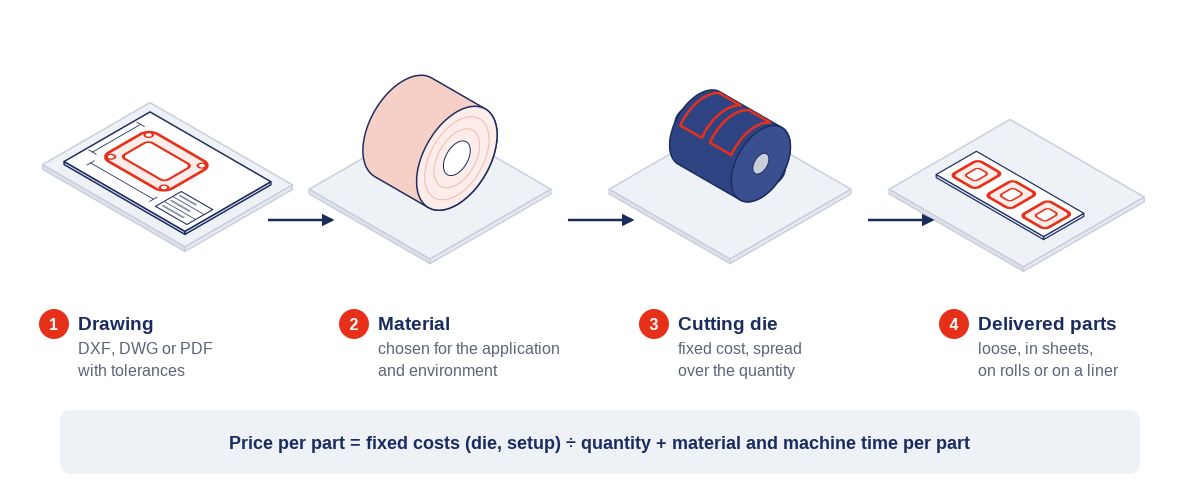
How a quote works at ATE
Alsace Techniques Étiquetage (ATE) is a converter based in France. Here is how a quote request is handled.
- You send your request through the contact form, with your drawing attached. If your project is confidential, we sign a non-disclosure agreement before you send the drawings.
- We review the drawing and the application.
- We suggest a material if you do not specify one, or if your specification leaves the choice open. We select it based on your application, your specification and our stock, from the more than 700 materials we convert. We can send you samples to confirm the choice.
- We prepare the quote: die, material, production and packaging.
- You receive the quote within 2 to 5 working days for a standard part.
Before production, we can cut toolless prototypes with digital cutting at ±0.1 mm accuracy, so you can test them on your own parts.
Mistakes that slow a quote down
- A drawing without dimensions or tolerances, or just a photo.
- An “equivalent” material with no part number and no description of its function.
- A single quantity with no annual volume: the process chosen may no longer suit production volumes.
- Nothing about how the part is applied: a part placed by a robot needs a suitable liner and packaging. See our article on release liners for automated application.
- Quality requirements raised after the quote, such as a PPAP for automotive. They change the documents and inspections to plan for. See our article on IATF 16949 supplier requirements.
Frequently asked questions
What information do I need to get a die-cut part quote?
A dimensioned drawing (DXF, DWG or PDF), the material or required function, the bonding surface, the environment, the quantities (prototype, production, annual volume), the delivery format, the application method and any quality requirements.
Which file formats does ATE accept for a quote?
DXF or DWG drawings, or a dimensioned PDF. A photo or screenshot is not enough, because it usually gives neither usable dimensions nor a reliable scale.
How long does it take to get a quote?
ATE issues a standard quote within 2 to 5 working days, based on a dimensioned drawing and information about the application.
Why does the price per part go down with quantity?
Because the fixed costs (cutting die and machine setup) are spread over more parts. The cost per part is: fixed costs ÷ quantity + material and machine time per part.
Can I get prototypes before production?
Yes. ATE cuts toolless prototypes with digital cutting at ±0.1 mm accuracy, so you can test them on your own parts before the production die is made.
My project is confidential: how do I send my drawings?
ATE signs a non-disclosure agreement before you send your drawings, if you ask for one.