Closed-cell foam resists the passage of water and air without relying on compression to close its cells, which is why it is often used outdoors. Open-cell foam lets water through when uncompressed, but some open-cell foams seal once compressed enough and generally retain their force better over time.
Updated November 2026. Values taken from the datasheets and sources cited in the text.
Choose the right foam for your gasket
What is the difference between open-cell and closed-cell foam?
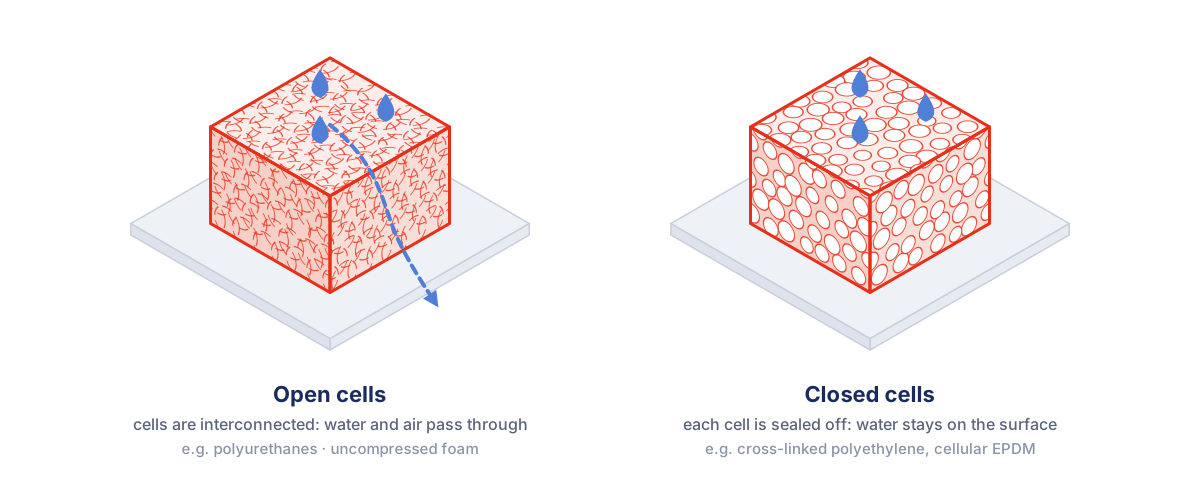
In open-cell foam, the cells are interconnected, like a sponge. In closed-cell foam, each cell is a small gas bubble sealed off from its neighbours.
Most foams are not purely one or the other. The US converter Marian uses two thresholds: more than 50% open cells for a foam to count as open-cell, and typically more than 70% closed cells for it to count as closed-cell. Most closed-cell foams therefore contain a few open cells, some of which may not have fully formed during expansion.
What each cell structure lets through
According to the gasket manufacturer Elasto Proxy, uncompressed open-cell foam lets air, water and chemicals through, while closed-cell foam resists them at low pressures. Saint-Gobain adds vapour and dust to the list of what closed cells keep out.
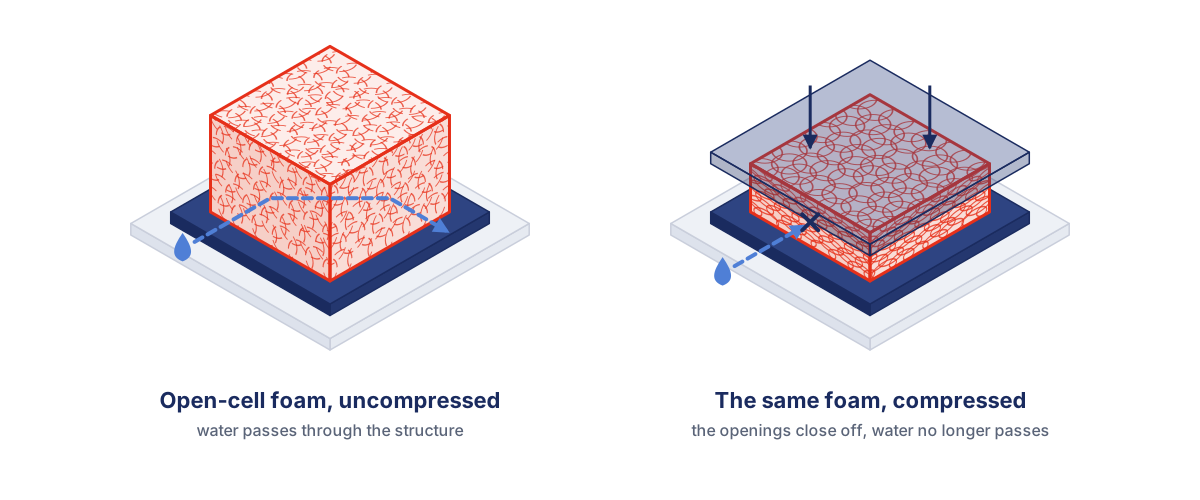
Compression changes the picture for open-cell foam. In its sealing and gasketing design guide, Rogers states that sealing effectiveness does not depend on an open or closed cell structure: once the foam is compressed enough, the openings in the cell walls close off. In its water sealing tests on six materials (neoprene, EPDM, PORON, silicone and others), at 1.5 psi (10.3 kPa) water pressure on a 0.25 in (6.35 mm) wide gasket, most formed a good seal at 50% compression or more, and sealing deteriorated as compression decreased.
Marian makes the same point about microcellular open-cell foams: they allow some ingress when uncompressed, and form a more effective seal once sufficiently compressed. Rogers makes this type of foam and Marian converts it: their view carries weight, but it is no substitute for testing on your own parts.
Over time: compression force and compression set
A gasket has to do more than seal on the day it is fitted. It has to keep pushing against the surfaces for years, and this is where the two structures differ.
- Closed cells can lose force. According to Marian, the gas trapped in the cells can permeate through the cell walls under constant compression, and some cells can rupture under pressure. The gasket then exerts less force.
- Microcellular open-cell foams generally retain force better. According to Marian, their structure is an interconnected web that does not depend on trapped gas. Rogers states that open-cell materials typically resist compression set and force relaxation better, but absorb more water when uncompressed.
To compare two foams on this point, read the compression set on their datasheets, measured under the same standard, temperature and recovery time. Our article on compression set in foam gaskets explains how to read these values and size the gasket.
Cellular PE and EPDM: what the datasheets say
Cross-linked polyethylene and cellular EPDM are the two foams we die-cut most for gaskets. Below are the values published for two closed-cell commercial grades, taken as examples.
| Property | Cross-linked PE (Palziv Galfoam GA29) | Cellular EPDM (Plaka, Leviat) |
|---|---|---|
| Cell structure | Closed cell | Closed cell (also available as semi-closed cell) |
| Density | 29 kg/m³, about 1.8 lb/ft³ (ISO 845) | 175 ± 25 kg/m³, about 11 lb/ft³ (ISO 845) |
| Water absorption | 1% by volume max. (internal method) | 5% max. (ASTM D1056) |
| Compression stress | 41 kPa (5.9 psi) at 25%, 103 kPa (14.9 psi) at 50% (ISO 844) | 35 to 63 kPa (5.1 to 9.1 psi) at 25%, 80 to 160 kPa (11.6 to 23.2 psi) at 50% (ASTM D1056) |
| Compression set | At 25% compression: 15.5% after 30 min, 7% after 4 h. At 50%: 36% after 30 min, 26% after 4 h (ISO 1856, test conditions not stated) | 25% max., 50% compression for 22 h at 23 °C / 73 °F (ASTM D1056) |
| Service temperature | -60 to 90 °C (-76 to 194 °F) | -30 to 100 °C (-22 to 212 °F) |
Sources: Galfoam GA29 and Plaka cellular EPDM datasheets. The standards and test conditions differ: read these figures grade by grade, not across columns.
Two lessons stand out:
- Compression level affects compression set. On this PE grade, compression set measured after 30 minutes rises from 15.5% to 36% when compression goes from 25% to 50%. Check the datasheet at the compression your gasket will actually see.
- “Cellular EPDM” does not always mean closed cell. The same range comes in a semi-closed cell version, and Saint-Gobain lists EPDM among the common bases for open-cell foams. Check the cell structure on the datasheet; the material name won’t tell you.
For outdoor use, Rogers notes that EPDM resists UV and ozone better than neoprene.
Open-cell or closed-cell: how to choose for your gasket
| Requirement | Preferred structure | Why |
|---|---|---|
| Water sealing, outdoors | Closed cell, for example cellular EPDM | Closed cells resist water at low pressure (Elasto Proxy); the converter Strouse associates them with outdoor use |
| Dust and air in an indoor enclosure | Closed cell (PE, EPDM), or well-compressed microcellular open cell | Both work if compression is sufficient across the whole gap, tolerances included |
| Permanent compression over many years | Compare datasheets; microcellular open-cell foams have the edge according to Rogers and Marian | Force retention and compression set |
| Cushioning, acoustics, void filling with no sealing | Open cell | Light and usually cheaper according to Strouse |
Source on uses and cost: Strouse.
What ATE does
Alsace Techniques Étiquetage (ATE), a converter based in France, mainly die-cuts cellular polyethylene and EPDM foams for gaskets. We also convert polyurethanes, including PORON, and cellular silicones.
- Die cutting gives the gasket its exact shape: rotary die cutting for production runs, toolless digital cutting for prototypes you test on your own parts.
- Laminating an adhesive onto the foam lets you fit the gasket without liquid glue, by hand or on an automated line.
- Material selection is made on datasheets, based on your application.
What to send us for a gasket quote
- The gasket’s function: water, dust, air, cushioning, acoustics.
- The gap to fill, minimum and maximum, with part tolerances.
- The environment: indoor or outdoor, temperatures, UV, chemicals.
- The expected service life and the number of open/close cycles, if any.
- The shape, how it will be fitted and the volume.
Frequently asked questions
What is the difference between open-cell and closed-cell foam?
In open-cell foam, the cells are interconnected. In closed-cell foam, each cell is a sealed gas bubble. According to Marian, a foam counts as open-cell above 50% open cells, and as closed-cell typically above 70% closed cells.
Can open-cell foam be used as a seal?
Yes, if it is compressed enough. Uncompressed, it lets water and air through. According to Rogers, its openings close off under sufficient compression, and in its tests on six materials (neoprene, EPDM, PORON, silicone and others), most formed a good seal at 50% compression or more.
Which foam is best for a waterproof gasket?
Closed-cell foam, such as cellular EPDM or polyethylene, is the usual choice, especially outdoors: it resists water without relying on compression to close its cells. For outdoor use, Rogers notes that EPDM resists UV and ozone better than neoprene.
Is polyethylene foam closed-cell?
Usually, yes. Saint-Gobain lists polyethylene among the common bases for closed-cell foams, and the cross-linked PE grade cited here (Galfoam GA29) is closed-cell. Check the structure on the datasheet.
Is cellular EPDM always closed-cell?
No. It comes in closed-cell and semi-closed cell versions, and Saint-Gobain also lists EPDM among the bases for open-cell foams. Check the cell structure on the datasheet of the specific grade.
Why does a closed-cell gasket lose force over time?
According to Marian, the gas trapped in the cells can permeate through the cell walls under constant compression, and some cells can rupture. The gasket then exerts less force on the surfaces. The compression set on the datasheet lets you compare foams on this point.