The short answer: a die-cut part is never generic — the industry writes the specification. Automotive demands IATF 16949 certification, PPAP submissions and lot-level traceability from its converters. Medical devices call for cleanroom production (ISO Class 7 at ATE) and adhesives documented against biocompatibility frameworks such as ISO 10993. Electronics needs low-outgassing materials that survive lead-free reflow soldering at 260 °C. Aerospace adds flammability, smoke and toxicity requirements (FAR/CS 25.853 type, depending on the application). Energy and battery applications put dielectric insulation and flame behaviour (UL 94 ratings) first. The guide below walks through each industry’s requirements, typical components and reference materials — with a comparison table you can act on.
At ATE, a 3M Preferred Converter certified to IATF 16949, we have spent more than 35 years die-cutting gaskets, spacers, insulators, thermal shields, sealing foams and technical labels for five industrial worlds, with production sites in France and Germany. One core capability — precision die cutting to tolerances below 50 µm with 100% automated inspection — but five radically different specifications. This page is the entry point: each industry has (or will soon have) its own dedicated page covering applications and materials in depth.
What Actually Changes From One Industry to Another
Before comparing industries, you need to know what to compare. Five parameters structure the specification of any die-cut component, whatever the market:
- The quality framework: IATF 16949 (automotive), ISO 13485 (medical devices), EN/AS 9100 (aerospace)… The framework determines the level of documentation, validation and audit readiness expected from your converter.
- The service environment: continuous and peak temperature, fluids, vibration, UV, thermal cycling. This is what selects the material family — see our guide to high-temperature adhesives by temperature threshold.
- Cleanliness and contamination control: particles, chemical leaching, outgassing. Decisive in medical and electronics — and the reason cleanroom (ISO Class 7) production exists.
- Traceability: from raw-material certificates to lot numbers on every package, up to full PPAP documentation in automotive.
- The delivery format: individual parts, sheets, kiss-cut rolls, or parts on liner for automated placement — a choice driven by your assembly process, not by ours.
Automotive: Zero-Defect Culture and PPAP
Automotive is the industry that has formalised its supplier requirements the furthest. Working for an OEM or a Tier 1 means accepting a framework: IATF 16949 certification, PPAP submission packages, FMEA, control plans and end-to-end traceability : material lot, work order and the inspection records that go with them.
Typical components: sealing and anti-vibration foam gaskets (PORON®, Volara®), die-cut spacers and gaskets for interior and engine-bay use, heat shields, bonding solutions for emblems and trim, plus process labels and rating plates that withstand fluids.
Material requirements: engine-bay temperature resistance (often 120–150 °C continuous), oil and fuel resistance, NVH (noise, vibration, harshness) behaviour — and, for electric vehicles, dielectric insulation and thermal-runaway protection on the battery side, a natural bridge to our energy section.
Medical: Cleanroom Production, Biocompatibility and Absolute Consistency

In medical devices, a die-cut part may sit against the patient’s skin — electrodes, advanced wound care, wearable sensors — or go inside a diagnostic consumable. The industry operates under ISO 13485, and any skin-contact application calls for adhesives formulated and documented against biocompatibility frameworks (ISO 10993).
What this means at converter level: cleanroom production (ISO Class 7) to control particulate contamination, materials with documented traceability (raw-material certificates retained), demonstrable process consistency — and no material substitution, ever, without customer revalidation.
Typical components: multilayer die-cut stacks for diagnostic devices (microfluidics, test strips), double-sided adhesives for wearable assembly, die-cut gaskets and filters, sterilisation and UDI identification labels.
Electronics: Reflow Survival, Outgassing and Thermal Management
Electronics imposes a double constraint that few materials reconcile: surviving the process (lead-free reflow soldering, 260 °C peak) and then performing flawlessly in service — low outgassing, stable dielectric properties, and sometimes thermal conduction or EMI shielding on top.
Typical components: flexible printed circuit (FPC) bonding, solder-masking in polyimide film (Kapton®), EMI shielding gaskets, die-cut thermal interface materials (gap pads), dielectric insulators, display spacers and bezels.
The differentiator is often invisible on the datasheet: cutting accuracy. On an FPC bond or a display spacer, a few tens of microns of deviation is enough to create an assembly defect — which is exactly where sub-50 µm tolerances and 100% automated inspection earn their keep.
Aerospace: Flammability, Weight and Material Traceability
Aerospace adds a specific regulatory dimension to the usual industrial requirements: fire behaviour. Cabin-installed materials must meet flammability, smoke and toxicity requirements (FAR/CS 25.853-type frameworks), and the industry works under EN/AS 9100 quality systems with airtight material traceability — every part must trace back to its raw-material certificate.
Typical components: die-cut thermal and acoustic insulation (Nomex®), reinforcements and protective layers (Kevlar®), cabin sealing gaskets, bonding solutions for interior trim, and technical labels resistant to hydraulic fluids.
The economics differ too: production runs are usually shorter than in automotive, documentation requirements are higher, and the materials themselves carry high value — which turns cutting-layout optimisation (nesting) into a genuine cost lever, because scrap is expensive.
→ Internal links: Aerospace market page (to be published) + technical materials article (Nomex®, Kevlar®).
Energy and Battery: Dielectric Insulation and Fire Behaviour
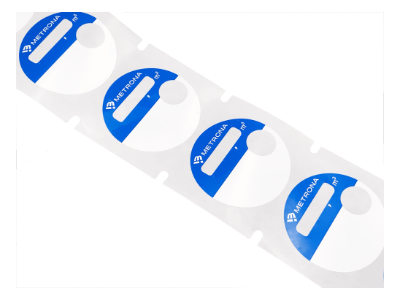 The energy sector, battery systems, power electronics, solar, wind, puts two properties first: dielectric insulation and fire behaviour (UL 94 ratings). Depending on the application, UV and outdoor-ageing resistance and stability under thermal cycling come next.
Typical components: busbar and battery-cell insulation, thermal barriers, sealing gaskets for power-electronics enclosures, compression pads for battery packs, and high-durability safety and identification labels.
This is the fastest-growing market of the five : driven by vehicle electrification and stationary storage, and the one where boundaries blur the most: a battery-pack insulator often has to satisfy the automotive, electronics and energy specifications all at once. The choice of adhesives in these situations is therefore of paramount importance.
The Comparison Table: Requirements by Industry
| Industry | Key frameworks | Dominant requirements | Typical die-cut parts | Reference materials |
| Automotive | IATF 16949, PPAP, OEM CSRs | Zero defect, lot traceability, 120 – 150 °C, fluids, NVH | Sealing foams, spacers, heat shields, trim bonding | PORON®, Volara®, 3M™ adhesives, PET |
| Medical | ISO 13485, ISO 10993 (biocompatibiliy) | ISO Class 7 cleanroom, process consistency, documented traceability | Diagnostic stacks, wearables, gaskets, UDI labels | Medical-grade adhesives, nonwovens, PE/PET films |
| Electronics | IPC, OEM specs, RoHS/REACH | 260 °C reflow survival, low outgassing, <50 µm accuracy | FPC bonding, solder masking, EMI gaskets, gap pads | Kapton®/polyimide, 3M™ 9077/9079, silicones |
| Aerospace | EN/AS 9100, FAR/CS 25.853 | Flammability-smoke-toxicity, material traceability, weight | Nomex® insulation, reinforcements, cabin gaskets | Nomex®, Kevlar®, qualified adhesives |
| Energy / Battery | U 94, battery OEM specs | Dielectric insuation, fire behaviour, thermal cycling | Busbar & cell insulation, thermal barriers | Polyimide/PET films, FR foams, silicones |
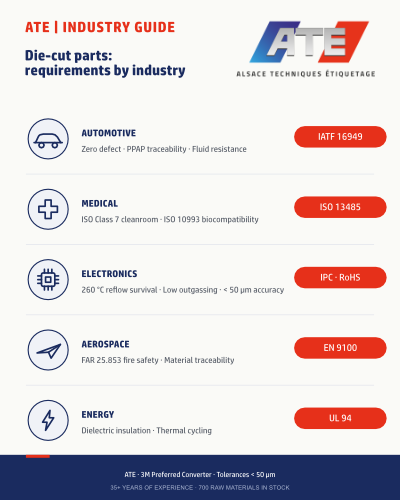
In industrial cutting, there is no SINGLE die-cut part, but rather numerous specifications to consider based on the project type. In this infographic, discover the requirements according to the sector for which the cut part is intended.
What Never Changes, Whatever Your Industry
Specifications diverge; the ATE method stays the same across all five markets:
- Material selection first: as a 3M Preferred Converter, we start from your service environment (temperature, substrate, mechanical load) to propose the right material/adhesive pairing — not the other way round.
- Precision die cutting: tolerances below 50 µm, complex multilayer constructions, liners and pull-tabs designed for your assembly station.
- 100% automated inspection: every part checked, not a sample — the enabling condition for zero-defect supply in automotive and medical alike.
- Production in France and Germany: a dual footprint, supply continuity and proximity to OEMs on both sides of the Rhine, serving customers in 23 countries.
FAQ — Die-Cut Parts and Technical Labels by Industry
What is a die-cut part?
A die-cut part is a functional component — gasket, spacer, insulator, foam pad, adhesive bond or label — cut to exact shape from a flexible or semi-rigid material (films, foams, nonwovens, double-sided adhesives). It performs a specific function inside an assembly: sealing, insulation, bonding, thermal protection or identification.
What certifications should a die-cutting supplier have for automotive work?
IATF 16949 is the baseline: it demonstrates process control, traceability and the ability to deliver the PPAP documentation OEMs and Tier 1s require. ATE is IATF 16949 certified across its production sites.
Why do medical die-cut parts need cleanroom production?
Because particulate contamination on a part can compromise a diagnostic device or a skin-contact adhesive. An ISO Class 7 cleanroom controls airborne particle concentration during converting and packaging — a standard expectation in medical-device specifications.
What materials survive lead-free reflow soldering at 260 °C?
Polyimide films (Kapton®) paired with silicone adhesives, and ultra-high-temperature acrylic tapes such as 3M™ 9077/9079, which are designed to survive a 260 °C reflow peak. Our high-temperature adhesives guide breaks this down threshold by threshold.
How do I choose a die-cutting converter for my industry?
Check three things: that its quality system covers your industry’s framework (IATF 16949, ISO 13485 environment, EN/AS 9100…), that its equipment matches your requirement level (cleanroom, automated inspection, tolerances), and that it selects materials from your service environment rather than from a catalogue. A converter serving several demanding industries at once — ATE’s model — is usually a good signal.
Your Industry Has Its Requirements. Let’s Talk About Yours.
Send us your drawing, your target material and your regulatory constraints: our teams will confirm feasibility, propose the right material/adhesive pairing and deliver prototypes cut to your dimensions.