In short: for continuous service up to 150°C, 3M™ high-performance acrylic adhesives (200MP and 100MP families) do the job. At 200°C, these acrylics only tolerate short exposures; sustained service requires ultra-high-temperature acrylics (3M™ 100HT) or silicone adhesives. 260°C is the territory of short, lead-free solder reflow exposures: 3M™ 9077/9079 tapes or silicone adhesives on polyimide film. The table below breaks down each tier, with values taken from 3M technical datasheets.
At ATE, a 3M Preferred Converter, this question comes up every week when specifying a die-cut part: gasket, spacer, insulator, flexible circuit attachment or process label. And the honest answer hinges on a nuance that product catalogs tend to blur: there is not one temperature rating, but two, continuous service temperature and short-term peak tolerance. Confusing them is the number one cause of bond failure in service.
“Short term” vs. “long term”: the distinction that changes everything
3M datasheets consistently list two values. For the 200MP acrylic adhesive (467MP / 468MP tapes), for example, the datasheet states short-period resistance (minutes, hours) up to 204°C and intermittent longer-period resistance (days, weeks) up to 149°C. [source: 3M TDS 467MP/468MP]
- Short term (peak): minutes to a few hours — typically an oven pass, a paint cure cycle or a solder reflow.
- Long term (continuous): days, weeks, or the entire life of the part — an engine compartment, a power electronics housing, a luminaire.
So the right question is not “which adhesive withstands 200°C?” but “for how long does the part see 200°C, under what mechanical load, and on which substrate?”
The 150°C tier: high-performance acrylics territory
Up to roughly 150°C continuous, high-performance acrylic adhesives cover the vast majority of industrial needs: nameplates, front panels, die-cut gaskets, engine trim attachment.
| AM adhesive (examples) | Continuous | Peak | Typical usee |
| 200MP acrylic (467MP, 468MP) | 149 °C | 204 °C | Nameplates, front panels, bonding PC/PET to metal |
| 100MP acrylic (F9460PC, F9469PC, F9473PC) | 149 °C | 260 °C | Thin structural bonding, engine environment autoclave |
Key difference between the two families: 100MP tolerates significantly higher peaks (260°C vs. 204°C) and keeps strong holding power when hot, the 3M datasheet specifies it holds a 1,000 g load for over 10,000 minutes at up to 149°C in static shear. For a part that undergoes a one-off thermal process and then lives at 120–140°C, it is often the right pick.
The 200°C tier: the grey zone where precision matters
No standard acrylic adhesive withstands 200°C continuously. That is the point this page needs to make clearly, because it is the one product datasheets are most often misread on.
- 200°C peaks (minutes/hours): 200MP goes up to 204°C, 100MP up to 260°C. A 200°C paint-cure oven pass is therefore feasible with these acrylics, to be validated against duration and load.
- Sustained 200°C: you need to step up. The 3M™ 100HT ultra-high-temperature acrylic family (9077 / 9079 tapes) is rated 150°C (9077) to 175°C (9079) long term, with peaks at 260–275°C. Beyond 175°C continuous, acrylics are out: silicone adhesives (often on polyimide backing) take over.
| 3M adhesives | Continuous | Peak | Typical use |
| 100HT acrylic — 9077 (double coated, non-woven) | 150 °C | 260 °C | FPC, electronic exposed to thermal processing |
| 100HT acrylic — 9079 (carrier-free transfer) | 175 °C | 275 °C | Thin ultra-high-temp bonding, better initial wet-out |
The 260°C tier: lead-free solder reflow and silicone adhesives
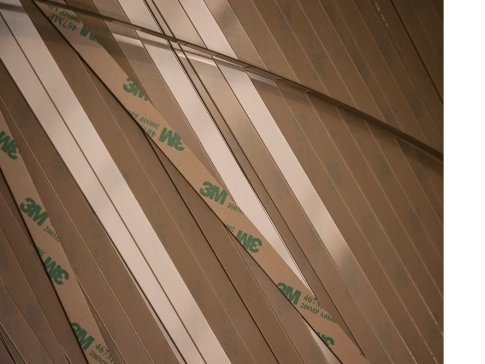
260°C is not a service temperature: it is the peak of a lead-free solder reflow profile (typically 260°C for ~40 seconds). This is the exact scenario 3M™ 9077 and 9079 tapes were designed for: both the adhesive and the liner survive the reflow oven, and the datasheet documents peel adhesion before and after reflow on polyimide and glass epoxy — the part stays in place and remains releasable after the cycle.
Flexible printed circuit (FPC) attachment: 9077 (better die-cutting behaviour) or 9079 (better initial adhesion), both low outgassing.
Repeated or continuous exposure above 175°C: silicone adhesives on polyimide film (Kapton® type), the benchmark for solder masking, bus bars and battery insulation — up to 260°C depending on grade. We cover these films in our article on technical films for electronics.
The summary table, tier by tier
| Tier | Adhesive solution | Continuous | Peak |
| ≤ 150°C | 3M™ 200MP HP acrylic (467MP/468MP) | 149 °C | 204 °C |
| ≤ 150°C | 3M™ 100MP HP acrylic (F9460/69/73PC) | 149 °C | 260 °C |
| ≤ 200°C | 3M™ 100HT UHT acrylic — 9077 | 150 °C | 260 °C |
| ≤ 200°C | 3M™ 100HT UHT acrylic — 9079 | 175 °C | 275 °C |
| 260 °C | 9077 / 9079 (lead-free reflow, ~40 s) | – | 260–275°C |
| 260 °C | Silicone adhesive on polyimide | up to 260°C* | 260°C+ |
Values from 3M technical datasheets (“typical values”, not for specification purposes).
Why these figures are not enough (and what ATE adds)
Datasheet values are measured under standardized conditions (ASTM D3654, 100 g to 1,000 g loads, stainless steel substrate). Your part may be bonding textured PET to a powder-coated housing, under vibration, with a daily thermal cycle. Three parameters change the answer:
- Substrate: 200MP and 100MP acrylics are not recommended on low surface energy plastics (PP, PE, powder-coated paints) — a point 3M datasheets state explicitly.
- Load: an adhesive “holds” at 150°C under 100 g; under permanent shear load, the margin shrinks fast.
- Die-cut format: bond area, peel direction, pull tabs — this is where precision die-cutting (tolerances below 50 µm at ATE) and liner selection make the difference, both at application and in service.
As an IATF 16949-certified 3M Preferred Converter, ATE selects the adhesive, die-cuts it to your exact part geometry and delivers ready-to-apply formats — sheets, rolls or parts on liner for automated placement.
FAQ — High temperature adhesive
Which double-sided adhesive withstands 150°C continuously?
3M™ high-performance acrylics 200MP (467MP/468MP) and 100MP (F9460PC/F9469PC/F9473PC) are rated 149°C continuous per their datasheets, with peaks of 204°C and 260°C respectively.
Is there an adhesive that withstands 200°C continuously?
Not a standard acrylic. 3M™ 9079 (100HT adhesive) reaches 175°C long term; beyond that, a silicone adhesive is required, usually on polyimide film.
Which adhesive survives lead-free solder reflow at 260°C?
3M™ 9077 and 9079 tapes are designed to survive a lead-free reflow profile peaking at 260°C (~40 s), notably for flexible printed circuit (FPC) attachment, with low outgassing.
What is the difference between short-term and long-term resistance?
Short term means exposures of minutes to a few hours (processing); long term means days, weeks or permanent exposure (service). Both values are listed separately on every 3M datasheet.
Is polyimide (Kapton®) tape a high temperature adhesive?
The polyimide film itself withstands well beyond 260°C; the adhesive is the limiting factor. Paired with a silicone adhesive, the construction handles repeated 260°C exposures, making it the benchmark for solder masking.
Does your part see more than 150°C? Let’s talk
Send us your drawing, substrate and thermal profile: our team will validate the right adhesive and provide samples die-cut to your dimensions. Contact ATE or request a prototype