In industrial converting, material selection is a critical engineering decision. A die-cut or laminated part performs very differently depending on whether it is built on a polyimide film, an acrylic foam, or an HDPE non-woven. Each substrate carries specific physical, thermal, chemical, and mechanical properties — and the major brands in the space, DuPont, 3M, Rogers Corporation, Sekisui, have established their product names as the default references in industrial specifications worldwide.
This article covers the main families of flexible materials used in converting, with for each: a description, key properties, sector applications, and how ATE processes the material.
At-a-Glance: All Flexible Materials
The table below gives a comparative overview of every material family covered in this guide — thermal range, key properties, differentiating strength, and primary industry sectors.
| Material | Family | Temp. Range | Key Properties | Differentiating Strength | Main Sectors |
| High-Performance Films | |||||
| Kapton® | Film | -269 °C to +400 °C | Electrical insulation, chemical, resistance, dielectric strength | Extreme thermal stability : from cryogenic to very high temperatures | Electronics, aerospaces, HT batteries, electric motors |
| Mylar® | Film | Up to ~150 °C | Dimensional stability, printability, moisture barrier | Versatile film: transparent, metalized or adhesive-backed | Labelling, electrical insulation, EMI shielding, packaging |
| Tedlar® | Film | −70 °C to +107 °C | Maximum UV resistance, low gas permeability, outdoor durability | The photovoltaic backsheet reference: unmatched long-terme UV resistance | Solar energy, aeronautics, architecture, waterproofing |
| Teflon® / PTFE | Film | -200 °C to +260 °C | Maximum non-stick, total chemical inertness, food contact approved | The most inert material available. Unaffected by solvents, acids or bases | Medical, food industry, industrial chemistry, HF electronics |
| Technical Foams | |||||
| VHB® 3M | Foam | −40 °C to +90 °C | Structural bonding, vibration absorption, double-sided PSA | Replaces screws and rivets. Structural adhesion on difficult surfaces | Automotive, electronics, construction, EV |
| Poron® | Foam | -40 °C to +90 °C | Compression resistance, elastic recovery, thousands of cycles | Does not compress over time. Consistent performance throughout product life | Electronic enclosures, automotive, wearables, EV modules |
| Bisco® | Foam | −60 °C to +230 °C | Low compression set at HT, ozone/UV resistance, UL/aero/rail approvals | The high-temperature gasket reference in regulated industries | Automotive, aeronautics, rail, HT batteries |
| Volara® | Foam | −40 °C to +80 °C | Closed cells, low water absorption, laminable surface | Ideal substrate for PSA lamination. Perfectly uniform density | Transport, medical, electronics, light construction |
| PE / PU / EPDM | Foam | Varies by grade |
|
Best performance-to-cost ratio for non-critical applications | Automotive, construction, industrial packaging, general sealing |
| High-Performance Materials | |||||
| Nomex® | Aramid | Up to +220 °C | continuous Thermal insulation, electrical insulation, does not melt | Dual thermal + electrical insulation. Chars without burning | Electric motors, transformers, EV/HEV, arc flash PPE |
| Kevlar® | Aramid | Up to +400 °C (short-term) | 5x steel strength, cut resistance, lightweight | Extreme mechanical strength. 5x stronger than steel at equal weight. | Defense, aeronautics, cable protection, cut-resistan PPE |
| Technical Nonwovens | |||||
| Tyvek® | Non-woven | Up to -70 °C | Sterile barrier, vapor permeable, compatible with steam / EtO / gamma sterilization | Liquid-impermeable AND vapor-permeable. Unique in its category | Medical (sterile packaging), construction (vapor barrier), PPE |
| Spunbond PP/PE · SMS · Sontara® | Non-woven | Varies by grade |
|
SMS : tri-layer bacterial barrier for sterilizable PPE and packaging | Medical, pharma, cleanroom, hygiene, PPE |
| Metal Substrates & Technical Papers | |||||
| Aluminium & copper films | Metal | Wide range depending on laminate |
|
Copper : maximum conductivity for high-performance RF shielding | Automotive, electronics, energy, industrial wiring |
| Technical & kraft papers | Paper | Standard to +150 °C (creped HT) |
|
The universal converting substrate: liner, masking, packaging, traceability | All sectors: labelling, masking, packaging, industrial, medical |
Kapton® — The Reference Polyimide Film by DuPont
What is Kapton ?
Kapton® is a polyimide film developed by DuPont in the late 1960s. Transparent with a characteristic amber-gold color, it has become the go-to material for any application requiring extreme thermal stability combined with excellent electrical properties. It is available as thin films (from a few microns to several hundred), adhesive tapes, and custom die-cut parts.
Technical Properties
Kapton® operates continuously from −269 °C to +400 °C without significant loss of mechanical performance — a range that puts it in a class of its own. It resists solvents, ionizing radiation, moisture, and chemical agents. Its high dielectric strength makes it a first-choice electrical insulator even in very thin layers.
| Thermal Range | Key Property | Solvent Resistance |
| -269 °C to +400 °C | Electrical insulation, chemical resistance | Excellent |
Sector Applications
Kapton® is essential in electronics (flexible circuits, winding insulation, component protection), aerospace (satellite cabling, rocket motor insulation), high-performance batteries, and next-generation electric motors.
Implementation at ATE
Precision rotary die-cutting of Kapton® films for electrical insulation parts, flexible gaskets, and thermal protection components in the electronics and automotive sectors. Processing available in ISO 7 cleanroom for microelectronics applications.
Mylar® — The High-Performance Biaxially Oriented PET Film by DuPont
What is Mylar ?
Mylar® is DuPont’s registered brand name for its biaxially oriented polyethylene terephthalate (PET) films : a plastic film that has been stretched in both directions (machine direction and cross direction) to optimize its mechanical properties. It is one of the most versatile plastic films available in industrial markets. The same material is also sold under the Melinex® brand (ICI/Teijin) for certain medical and display applications.
Technical Properties
Mylar® stands out for its high dimensional stability, low elongation, good tear resistance, and excellent printability. It handles moderate temperatures (up to around 150 °C) and resists humidity well. Available in transparent, metalized, or adhesive-backed versions, it forms the backbone of many multi-layer laminates. It is often compared directly to Kapton® or to standard polyester films depending on the application context.
| Thermal Range | Key Property | Available Formats |
| Up to 150 °C | Dimensional stability, printability | Transparent, metalized, adhesive-backed |
Sector Applications
Electrical insulation, electromagnetic shielding, high-performance industrial packaging, durable labeling, display films, medical packaging. The metalized version is widely used as a thermal barrier and reflector in energy applications.
Tedlar® — The PVF Film by DuPont
What is Tedlar ?
Tedlar® is a polyvinyl fluoride (PVF) film developed by DuPont in the 1960s. Its smooth, non-porous surface makes it difficult to contaminate and easy to clean — two properties that are highly valued in demanding industrial environments.
Technical Properties
Tedlar® delivers exceptional resistance to UV, weathering, and chemical agents, along with very low gas permeability. It retains its mechanical and optical properties after years of outdoor exposure, making it one of the most durable films on the market. Due to its premium characteristics, Tedlar® commands a significantly higher price than conventional films but the trade-off is substantially longer service life.
| Key Property | Gas Barrier | Durability |
| Maximum UV resistance | Very low permeability | Excellent outdoors |
Sector Applications
Photovoltaic panel backsheets, exterior protective coatings in aeronautics, architecture (cladding, membranes), industrial waterproofing. The benchmark material for any application requiring long-term UV resistance outdoors.
Teflon® / PTFE — The DuPont Fluoropolymer
What is Teflon / PTFE?
Teflon® is DuPont’s registered brand for its polytetrafluoroethylene (PTFE) products. PTFE is one of the most chemically inert synthetic materials in existence, available as thin films, tapes, coated fabrics, or machined parts. Its composition, entirely fluorine-bonded, makes it extreme across virtually all properties, and an ideal choice for any application involving aggressive chemicals or sensitive products.
Technical Properties
PTFE combines exceptional characteristics: maximum non-stick surface, near-total chemical resistance (acids, bases, solvents), thermal stability from −200 °C to +260 °C. Its coefficient of friction is among the lowest of any known solid. It is also biocompatible and approved for food contact. PTFE’s surface is essentially non-adhesive, which makes it a challenging substrate to bond — surface treatment (such as corona treatment) is typically required before lamination.
| Thermal Range | Key Property | Food Contact |
| -200 °C to +260 °C | Non-stick, total chemical inertness | Approved |
Sector Applications
Medical (filtration membranes, biocompatible gaskets), food processing (non-stick surfaces, process seals), industrial chemistry (acid-resistant sealing), electronics (high-frequency insulation). PTFE is also the base material for high-temperature masking tapes used in painting and surface treatment processes.
Implementation at ATE
Rotary die-cutting of PTFE films and tapes for gaskets, membranes, and insulation parts. Processing available in ISO 7 cleanroom for medical and food-contact applications.
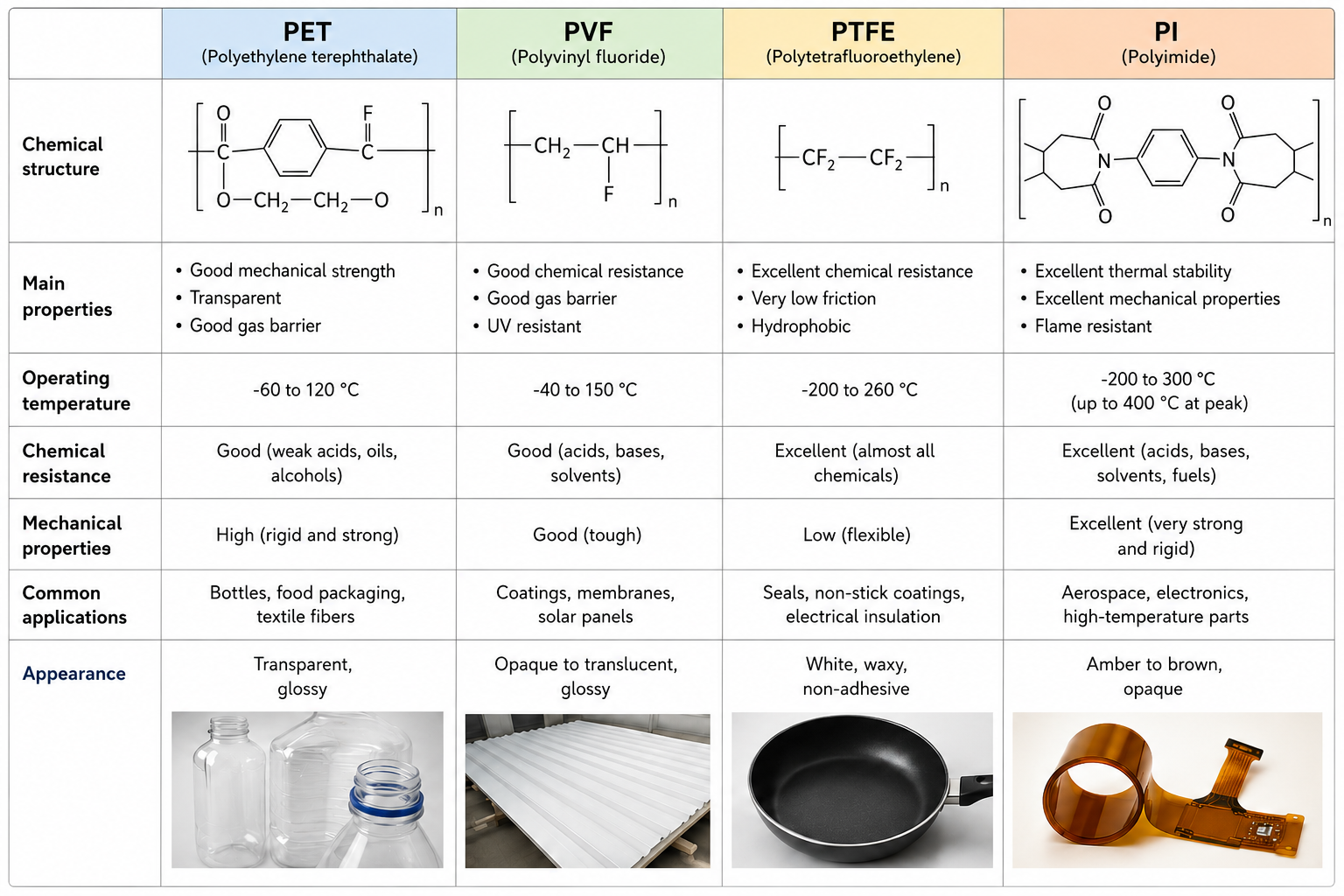
PET, PTFE, PVF, Polyimide — Key Differences for Industrial Applications
Before moving to foams and other material families, the table below summarizes the critical differences between the plastic films covered above, thermal range, chemical resistance, and best-fit use cases, to help specify the right substrate for a given project.
VHB® — 3M’s High-Bond Acrylic Foam Tape
What is VHB ?
VHB® (Very High Bond) is 3M’s range of high-performance double-sided acrylic foam tapes. More than a simple adhesive, VHB® is a viscoelastic acrylic foam capable of replacing mechanical fasteners — screws, rivets, welds — in assemblies subject to high stress.
VHB® vs. Standard Double-Sided Tape
A standard double-sided tape transfers stress directly between the two bonded surfaces. VHB®, thanks to its viscoelastic acrylic foam core, absorbs and redistributes stresses — vibrations, impacts, differential thermal expansion — while maintaining the assembly. This absorption capacity is what allows it to replace mechanical fasteners in structural applications.
Technical Properties
Strong adhesion to difficult surfaces (painted metals, stainless steel, glass, composites), vibration absorption, compensation of differential thermal expansion between dissimilar materials, stable performance over a wide temperature range. Certified for numerous structural applications.
| Type | Key Property | Main Sectors |
| Double-sided acrylic foam | Structural bonding, vibration absorption | Automotive, electronics, construction, EV |
Sector Applications
Body panel assembly, badge and reinforcement bonding, electronic module mounting, glazing installation in construction, signage and display panel fixing. VHB® is also widely used in electric vehicles for battery module assembly.
Implementation at ATE
As a 3M Preferred Converter, ATE precision-cuts VHB® foam into custom parts (gaskets, assembly reinforcements, fixing pads) for customers in the automotive, electronics, and energy sectors.
Poron® — Rogers Corporation’s Microcellular Polyurethane Foam
What is Poron ?
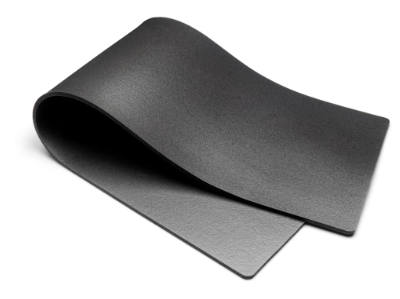
Poron® is an open-cell microcellular polyurethane foam manufactured by Rogers Corporation. Its fine, uniform cell structure gives it properties that standard PU foams simply cannot match.
Technical Properties
Unlike standard PU foams that compress and take a set under prolonged load, Poron® delivers high creep resistance and excellent elastic recovery after thousands of compression cycles. It does not stiffen over time, guaranteeing consistent performance throughout the product’s entire service life.
| Type | Key Property | Durability |
| Microcellular PU, open cell | Creep resistance, compression set | Thousands of cycles without degradation |
Sector Applications
Precision sealing gaskets for electronic enclosures, damping pads in automotive control modules, protection in portable devices and wearables, acoustic plug gaskets, mounting pads for EV battery modules.
Implementation at ATE
Rotary die-cutting of Poron® gaskets and pads for electronic enclosures and automotive sealing applications — tight tolerances, kiss-cut on liner available.
Bisco® — Rogers Corporation’s High-Performance Cellular Silicone
What is Bisco ?
Bisco® is Rogers Corporation’s range of technical silicones, available in cellular (foam), sponge, and solid versions. It is recognized as the global reference for gasket and sealing applications in extreme environments.
Technical Properties
Operating range from −60 °C to +230 °C, resistance to ozone, UV, and industrial fluids, low compression set at high temperature. UL, aeronautics (FAR 25.853), and railway (EN 45545) approvals make it the material of choice in regulated industries.
| Thermal Range | Key Property | Approvals |
| -60 °C to +230 °C | HT gasket, low compression set | UL, aeronautics, railway |
Sector Applications
Door and hood gaskets for vehicles, fire barriers in aircraft and trains, high-voltage electrical insulation foams, acoustic protection, gaskets for high-voltage battery enclosures in EVs.
Volara® — Sekisui’s Irradiation Cross-Linked Polyolefin Foam
What is Volara ?
Volara® is an irradiation cross-linked polyolefin foam manufactured by Sekisui. Its closed-cell structure and smooth surface make it a preferred substrate for laminating pressure-sensitive adhesives.
Technical Properties
Smooth, uniform surface, homogeneous density, very low water absorption, and low vapor transmission. Resistant to most common chemical agents, with excellent thermal and acoustic insulation properties. Available in several grades (Type A, AF, AS, etc.) to match specific application requirements. Its near-zero water absorption and low vapor transmission are the core differentiators.
| Type | Key Property | Surface |
| XLPE, closed cell | Sealing, low water absorption | Smooth, uniform, laminable |
Sector Applications
Protective cushioning in transport (interleaving, dunnage), light construction gaskets, medical tapes (fixation pads), lightweight insulation in consumer electronics and automotive.
PE, PU, EPDM Foams — Industrial Technical Foam Solutions
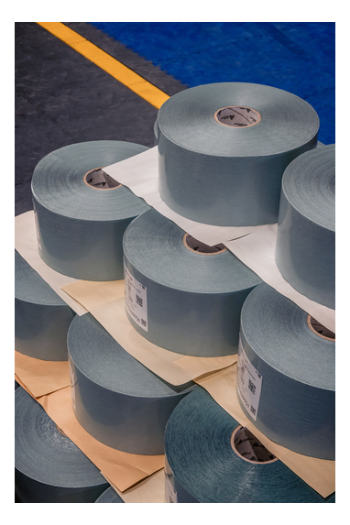
Beyond branded reference materials, industrial converting relies on a broad range of generic technical foams selected on the basis of performance-to-cost ratio and project specification fit.
Polyethylene (PE) Foam
Lightweight, moisture-resistant, good thermal and acoustic insulation. Available in cross-linked version (PE-X) for improved mechanical properties and a more uniform surface. Widely used for cushioning, industrial packaging, and surface protection interleaving. Its low cost makes it the most common foam for non-critical applications.
Polyurethane (PU) Foam
Flexible, good resilience, wide range of available densities. Open-cell versions are especially effective for air filtration and flow control. Closed-cell versions deliver better sealing performance. Used in weatherstrip sealing, acoustic damping, padding, and lightweight protection.
EPDM Foam (Ethylene Propylene Diene Monomer Rubber)
Excellent resistance to weathering, ozone, and UV — highly stable over time in outdoor exposure. Primarily used for outdoor sealing gaskets in automotive (body, trunk, door seals), construction (glazing, facades), and energy (outdoor cabinets, electrical enclosures).
What Are PE, PU, EPDM Used For ?
| PE | PU | EPDM |
| Cushioning, protection, packaging | Sealing, acoustic, filtration | Outdoor weatherstripping, automotive gaskets |
Implementation at ATE
Rotary die-cutting of PE, PU, and EPDM foams into custom parts, with or without adhesive. Double-face lamination available to simplify customer assembly.
Nomex® — DuPont’s Meta-Aramid Fiber
What is Nomex ?
Nomex® is a meta-phenylenediamine aramid fiber developed by DuPont, available as paper, fabric, or technical felt. Its most remarkable property: it does not melt, does not drip, and chars without igniting at very high temperatures. It’s a critical characteristic in electrical safety and fire protection applications. A well-known example: Nomex® is the material used in firefighter suits and Formula 1 driver overalls.
Note: DuPont transferred the Nomex® brand to Arclin in the course of 2026.
Technical Properties
A unique dual performance: intrinsic thermal and electrical insulation in a single material. High tear and abrasion resistance, dimensional stability under heat, good chemical resistance to oils and lubricants. Nomex® paper is manufactured from aramid floc and can be resin-impregnated to enhance mechanical properties.
| Type | Key Property | Fire Behavior |
| Meta-aramid, paper / fabric / felt | Thermal + electrical insulation | Does not melt or drip |
Sector Applications
Inter-winding insulation in electrical transformers, electric motor insulation (automotive, wind turbines, industrial), thermal protection in electric and hybrid vehicles, personal protective equipment (PPE) for workers exposed to electric arc flash and fire.
Implementation at ATE
Rotary die-cutting of Nomex® parts for electric motor and transformer insulation — energy, automotive, and electric vehicle sectors.
Kevlar® — DuPont’s High-Strength Para-Aramid Fiber
What is Kevlar ?
Kevlar® is a para-phenylenediamine aramid fiber developed by DuPont. In industrial converting, it is primarily encountered as fabric, unidirectional plies, or composite films. Its processing requires dedicated cutting tools due to its abrasive nature. A familiar example: Kevlar® is the fiber used in ballistic vests and Formula 1 monocoque shells.
Technical Properties

Kevlar® is stronger than steel in tension at equal weight. Exceptional strength-to-weight ratio: 5× stronger than steel at the same mass. Excellent abrasion, cut, and elongation resistance. Stable at temperatures up to 400 °C in short-term exposure — maintaining mechanical properties where most polymers soften.
| Tensile Strength | Key Property | Thermal Stability |
| 5x steel at equal weight | Cut resistance, lightweight, abrasion resistance | Up to 400 °C (short-term) |
Sector Applications
Lightweight ballistic protection (defense, security), structural reinforcement for composites (aeronautics, sport), mechanical protection for industrial cables and pipes, wear parts in process equipment, cut-resistant gloves and PPE.
Technical Non-Wovens
Tyvek® — DuPont’s High-Density Polyethylene Non-Woven
What is Tyvek ?
Tyvek® is a flash-spun high-density polyethylene (HDPE) non-woven sheet developed by DuPont in the late 1950s. It resembles paper in appearance but its properties are fundamentally different.
In short: Tyvek® is a polyethylene sheet whose fibrous structure blocks liquids and particles while allowing water vapor to pass through.
Technical Properties
Tyvek® combines properties that appear contradictory: impermeable to liquids yet vapor-permeable, tear-resistant yet lightweight, a particle barrier yet breathable. Its chemical resistance to dilute acids and bases, combined with compatibility with the main sterilization processes (steam, ethylene oxide, gamma radiation), makes it a medical sector reference.
| Type | Key Property | Sterilization Compatibility |
| Flash-spun HDPE non-woven | Sterile barrier, vapor permeable | Steam, EtO, gamma |
EtO = Ethylene Oxide sterilization
Sector Applications
Medical sterile packaging (pouches and envelopes for medical devices), vapor barriers and facade wraps in construction, industrial protective packaging, disposable PPE (coveralls, caps), protective envelopes for sensitive shipments.
Implementation at ATE
Rotary die-cutting of Tyvek® for sterile medical packaging and industrial protection. Processing in ISO 7 cleanroom for critical medical applications requiring a controlled environment.
Sontara® and Other Technical Non-Wovens: Spunbond and SMS
The technical non-woven family covers a wide variety of structures and performance levels. Beyond Tyvek®, converters regularly process several complementary types. These non-wovens are primarily used in medical and pharmaceutical sectors due to the stringent requirements of those industries.
Spunbond PP / PE
Extruded and thermally bonded fibers — no chemical binder. Lightweight, economical, tear-resistant. Used in industrial filtration, hygiene, non-food packaging, and agriculture (crop protection covers). Spunbond PP is the base for many lightweight medical packaging applications.
SMS (Spunbond-Meltblown-Spunbond)
A tri-layer structure combining two spunbond layers around a meltblown core of ultrafine fibers. The central layer provides a bacterial and aerosol barrier that single-layer spunbond cannot achieve. The reference structure for sterilizable medical packaging and protective PPE (masks, surgical gowns).
Sontara® (DuPont)
A hydroentangled non-woven based on polyester and/or cellulose fibers. Its binder-free manufacturing process delivers high mechanical strength, exceptional softness, and very low particle emission — three essential qualities for medical, pharmaceutical, and cleanroom environments. Used in technical wipers, examination sheets, and surgical drapes.
| Spunbond | SMS | Sontara® |
| Filtration, hygiene, packaging | Medical barrier, PPE | Medical, pharma, cleanroom |
Metal Substrates & Technical Papers
Aluminium & Copper Films
Metal films, primarily aluminium and copper, form a distinct material family in converting. As thin adhesive foils or composite films, they serve two main functions: electromagnetic shielding and thermal management.
Adhesive Aluminium Film
Used for lightweight EMI shielding, reflective thermal insulation, and protection of sensitive components. In automotive applications, it shields wiring harnesses, electronic control unit housings, and underhood heat screens. Its ease of processing and moderate cost make it the most common choice for first-level shielding.
Adhesive Copper Film
More conductive than aluminium, copper film is preferred for high-performance RF shielding, grounding connections, and certain power electronics applications. Also used in PCB design for ground planes and electrostatic discharge (ESD) protection. Its higher cost limits it to applications where maximum conductivity is required.
| Aluminium | Copper | Main Sectors |
| Thermal insulation, EMI shielding | RF shielding, grounding | Automotive, electronics, energy |
Implementation at ATE
Rotary die-cutting and lamination of adhesive aluminium and copper films for EMI shielding, thermal protection, and electrical connections in the automotive and electronics sectors.
Technical & Kraft Papers
Technical papers cover a broad spectrum in industrial converting. Unlike standard printing papers, they are engineered to meet specific requirements in terms of strength, barrier properties, or compatibility with industrial processes.
Kraft Paper
Kraft paper (unbleached or bleached) is one of the most common substrates in converting. Strong in tear and tensile strength, it is used as a protective interleaf between metal parts, as a silicone-coated liner for labels and pressure-sensitive adhesives, and as industrial protective packaging for machined parts and components.
Specialty Papers
Technical specialty papers cover several well-defined sub-families:
- Creped paper: the base for masking tapes used in painting and surface treatment. Its crinkled structure allows it to conform to curves.
- Silicone-coated paper: the reference liner for self-adhesive labels and pressure-sensitive adhesives. Grammage and silicone coating weight are matched to the adhesive system.
- Antistatic paper: packaging for electronic components sensitive to electrostatic discharge (ESD) — protects against damage during transport and storage.
- Medical-grade paper: designed for packaging sterilizable by steam or ethylene oxide. Permeable to sterilization agents, resistant to process humidity.
| Kraft | Creped / Silicone-coated | Specialty |
| Interleaving, protection, liner | Masking, label liner | Antistatic, medical-grade |
Implementation at ATE
Flexographic and screen printing on technical papers, die-cutting of liners, interleaves, and industrial labels. Manufacture of specialty paper labels for traceability and identification in harsh industrial environments.
Conclusion
The phenomenon of brand genericization goes far beyond the converting industry. Velcro® entered the dictionary before most people knew it was a registered trademark. Scotch® from 3M became the French generic term for transparent adhesive tape. Plexiglas® has virtually replaced ‘acrylic glazing’ in everyday language. Nylon®, registered by DuPont in the 1930s, is now used as a generic term in virtually every language without anyone finding it unusual.
ATE Processes Virtually All of These Materials
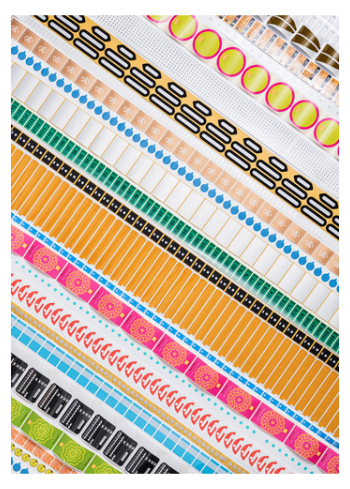
Since 1989, Alsace Techniques Étiquetage (ATE) has specialized in the custom converting of adhesive and non-adhesive flexible materials for B2B customers in the automotive, medical, electronics, energy, and food sectors. All material families presented in this guide fall within our converting capabilities.
Our processes cover precision rotary die-cutting, flexographic and screen printing, and multi-layer lamination / complexing. Our ISO 7 cleanroom allows us to process the most sensitive materials under controlled conditions, in compliance with medical and microelectronics sector requirements.
As a 3M Preferred Converter, we benefit from priority access to 3M materials and dedicated technical support for complex projects. Our subsidiary Rototechnix manufactures rotary tooling in-house, allowing us to precisely match cutting geometry to the most demanding substrates — including fragile films, compressible foams, and abrasive materials such as Kevlar®.
IATF 16949 – ISO 14001 – ISO 45001 – ISO 7 Cleanroom – UL Certified – 3M Preferred Converter
Have a project on a specific material?
Our technical team reviews your specifications and proposes a cutting or laminating solution tailored to your requirements.