If you’ve ever received an RFP specifying ISO 7, or if a new medical or aerospace contract requires cleanroom-manufactured components, you’re not alone in needing to understand exactly what that means — and whether the manufacturer you’re evaluating actually meets that standard for the specific processes you need. This guide cuts through the regulatory language and gives you the practical framework to make that call.
We cover ISO 14644-1 cleanroom classifications, what each class means in real manufacturing terms, the specific requirements of ISO 7, and what to look for when qualifying a cleanroom-certified converting or labeling partner.
1. What Is a Cleanroom? The Basics
A cleanroom is a controlled manufacturing environment where airborne particle concentration, temperature, humidity, and pressure are monitored and regulated to prevent contamination. The goal is straightforward but operationally demanding: keep the production environment clean enough that it doesn’t compromise the product being made inside it.
Cleanrooms are not binary — they exist on a spectrum of cleanliness. A semiconductor fab and a medical device packaging line both operate in cleanrooms, but the level of control required is completely different. That’s exactly what ISO 14644-1 defines.
What is ISO 14644-1?
ISO 14644-1 is the international standard that defines cleanroom air cleanliness based on airborne particle concentration. Published in 1999 and revised in 2015, it replaced the U.S. Federal Standard 209E — which classified rooms as Class 100, Class 1,000, Class 10,000, etc. based on particles per cubic foot — with a metric-based, globally harmonized system of ISO Classes 1 through 9.
The classification is simple in principle: it measures the maximum number of particles of a given size allowed per cubic meter of air. Lower ISO number = fewer particles allowed = cleaner environment.
2. ISO 14644-1 Cleanroom Classes: Full Classification Table
The table below maps all nine ISO classes to their particle limits, former U.S. Federal Standard equivalents, and typical industry applications:
| ISO Class | Max. particles ≥0.5µm per m³ | Former US Standard | Typical Applications |
| ISO 1 | 10 | – | Nanotechnology, quantum device research |
| ISO 2 | 100 | – | Advanced semiconductor R&D |
| ISO 3 | 1,000 | Class 1 | Semiconductor wafer processing |
| ISO 4 | 10,000 | Class 10 | Hard disk manufacturing, precision optics |
| ISO 5 | 100,000 (3,520 at ≥0.5µm) | Class 100 | Sterile injectables (pharma), aseptic fill/finish, Grade A/B (EU GMP) |
| ISO 6 | 35,200 | Class 1,000 | Implants, biotech, buffer zone for ISO 5 |
| ISO 7 | 352,000 | Class 10,000 | Medical device assembly, precision adhesive converting, diagnostics, electronics |
| ISO 8 | 3,520,000 | Class 100,000 | Secondary packaging, non-sterile device assembly, controlled storage |
| ISO 9 | 35,200,000 | — | Controlled but unclassified environments |
Note: ISO 5 corresponds to EU GMP Grade A/B (pharmaceutical) and is the standard for aseptic sterile manufacturing. ISO 7 corresponds to EU GMP Grade C and is the most widely used cleanroom class in medical device manufacturing and precision industrial converting.
3. ISO 7 Cleanroom: What It Actually Requires
ISO 7 — formerly known as Class 10,000 — is the workhorse of industrial cleanroom manufacturing. It is the most common classification for medical device component production, precision adhesive converting, and controlled assembly of electronics and aerospace components. Here is what maintaining ISO 7 certification actually requires:
| Parameter | ISO 7 Requirement | Notes |
| Max. particles ≥0.5µm per m³ | 352,000 | Verified by calibrated laser particle counters |
| Max. particles ≥5.0µm per m³ | 2,930 | Critical for surfaces exposed to adhesive or sterile components |
| Air changes per hour (ACH) | 30–60 ACH | Higher ACH for more critical processes within the room |
| Filtration | HEPA (≥99.97% efficiency at 0.3µm) | 15–25% ceiling filter coverage minimum |
| Airflow pattern | Turbulent controlled (non-unidirectional) | Unidirectional required for ISO 5 and below |
| Pressure differential | Positive pressure vs. adjacent areas | Prevents particle ingress; typically +5 to +20 Pa |
| Temperature / humidity | 18–22°C / 30–60% RH (process-dependent) | Controlled to prevent material and adhesive variability |
| Gowning | Cleanroom suit, gloves, hair/beard cover, shoe covers | Personnel are the #1 source of contamination |
| Certification frequency | As required by ISO 14644-2 (typically annual) | Particle counts at rest and in operation |
One point that surprises many procurement engineers: ISO class defines air cleanliness only. Room size, ceiling height, layout, and equipment configuration are determined by your process requirements — not by the ISO number. A facility that over-specifies ISO 5 when ISO 7 meets its regulatory requirements pays significantly more in HVAC, energy, and operational complexity for no product quality benefit.
4. ISO 7 vs ISO 8: Which Classification Does Your Application Require?
This is the most practical question for any procurement manager or design engineer qualifying a manufacturing partner. The answer depends on two things: the nature of your product’s contamination risk, and the regulatory framework that governs it.
| Application | Required Class | Rationale |
| Sterile injectable drug manufacturing | ISO 5 (Grade A/B) | Direct contact with sterile product; zero tolerance for contamination |
| Implantable medical device assembly | ISO 6-7 | Direct patient contact in sterile or semi-sterile zones |
| Wound dressing / surgical drape manufacturing | ISO 7 | Skin contact product, contamination affeects patient safety |
| Diagnostic devise assembly (non-sterile) | ISO 7-8 | Depends on exposure risk and regulatory classification |
| Precision adhesive label converting (medical) | ISO 7 | Required for UDI-compliant labels and device surface adhesion integrity |
| Wearable / skin-contact electronics | ISO 7 | Adhesive performance and biocompatibility require controlled environment |
| Secondary packaging of non-sterile devices | ISO 8 | Low contamination risk; ISO 8 provides adequate control |
| Electronics PCB assembly (non-medical) | ISO 7-8 | ESD and particle control; class varies by component sensitivity |
| Aerospace adhesive and gasket components | ISO 7 | Long service life and structural integrity require controlled production |
Not sure whether your application requires ISO 7 or ISO 8 manufacturing? ATE’s technical team can assess your product and regulatory requirements and recommend the right production environment for your components.
Talk to a cleanroom manufacturing specialist
5. Cleanroom Converting: Adhesive Die Cutting, Laminating, and Labeling in a Controlled Environment
The term ‘cleanroom converting’ refers to the precision transformation of flexible materials — films, foams, adhesive constructions, labels — carried out inside an ISO-classified environment. It is a specialized discipline that sits at the intersection of contamination control and materials engineering.
Not all converters operate in cleanrooms. And among those that do, the level of process integration varies significantly. Here is what cleanroom converting in an ISO 7 environment actually involves:
Precision die cutting in cleanroom conditions
Rotary and flat-bed die cutting of adhesive films, medical tapes, foams, and laminates must be performed in a cleanroom when the finished component will be used in medical devices, diagnostics, or wearable electronics. Particle contamination on a pressure-sensitive adhesive surface can cause bonding failures, delamination, or microbiological risk in skin-contact applications.
In an ISO 7 cleanroom, all cutting tools, raw material roll handling, and finished component packaging are managed under controlled contamination conditions. This is especially critical for materials such as medical-grade polyurethane films, silicone adhesives, hydrocolloids, and non-woven constructions.
Multi-layer lamination and complexing
Multi-layer adhesive constructions — where two or more functional layers are bonded together to create a specific combination of properties — require cleanroom conditions whenever the bonded interface must remain free from particulate contamination. Trapped particles between layers cause visible defects, mechanical weakness, and adhesion variability.
ATE’s ISO 7 facility handles full multi-layer lamination and complexing operations, including constructions combining polyimide (Kapton), polyester, aluminium foil, foam, and precision adhesive layers for medical, electronic, and aerospace applications.
Cleanroom label production and printing
Labels produced for medical devices must meet increasingly stringent requirements: they must adhere reliably to sterilized surfaces, survive the sterilization process itself (EtO, gamma, autoclave), carry machine-readable GS1 DataMatrix codes, and be produced in an environment that prevents particulate or microbiological contamination of the adhesive surface.
ATE produces UDI-compliant labels with GS1 DataMatrix encoding, flexographic and screen printing, and precision die cutting — all within the ISO 7 controlled environment.
Learn more about our medical label production capabilities
6. The Four Engineering Pillars of ISO 7 Compliance
1. HEPA filtration and air handling
HEPA filters (High Efficiency Particulate Air) retain at least 99.97% of particles ≥0.3 µm. ISO 7 requires HEPA filtration covering 15–25% of the ceiling area, delivering 30–60 air changes per hour. The air handling unit (AHU) recirculates the cleanroom air continuously through the HEPA filter bank, maintaining the required particle concentration under operational conditions — i.e., with personnel and equipment running.
2. Airflow pattern and pressure cascade
ISO 7 uses turbulent (non-unidirectional) airflow, which is less expensive to achieve than the laminar flow required for ISO 5 and above. Critically, the room must be maintained at positive pressure relative to adjacent areas — typically between +5 and +20 Pascals — so that any air leakage flows outward, not inward, preventing particle ingress from less controlled spaces. In multi-zone facilities, a pressure cascade from cleanest to least clean zones creates a contamination barrier across the entire facility.
3. Materials and architectural design
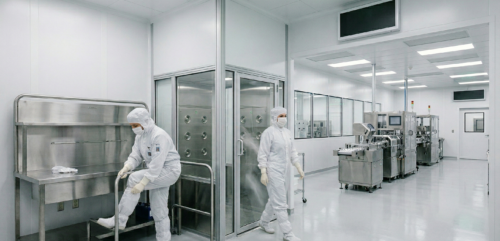
Cleanroom surfaces must be smooth, non-porous, chemically resistant, and non-particle-generating. Walls, floors, ceilings, and built-in equipment must not shed particles during normal operation or cleaning. Joints, corners, and penetrations (cable passes, pipe entries) must be sealed and coved. In a converting environment, all process equipment — slitters, die cutting presses, lamination stations — must be cleanroom-compatible: no painted surfaces, no particle-generating components, no external lubricants that could migrate onto product surfaces.
4. Personnel protocols and gowning
The human body is the single largest source of contamination in any cleanroom. A person at rest generates approximately 100,000 particles per minute; in motion, that figure increases tenfold. ISO 7 gowning protocols typically require a full cleanroom suit (coverall), shoe covers, hair and beard covers, gloves, and — depending on process criticality — a face mask. Entry airlocks with sticky mats and gowning benches prevent particle transfer from external areas into the controlled environment. Behavioral protocols (no cosmetics, no hand lotions, controlled movement, no cardboard inside the cleanroom) are as important as hardware.
7. ISO 14644 Beyond Part 1: The Standards That Keep a Cleanroom Compliant
ISO 14644-1 defines classification. The rest of the ISO 14644 family governs how that classification is maintained, verified, and operated over time:
| Standard | Scope | Practical implication for buyers |
| ISO 14644-1 | Classification of air cleanliness by particle concentration | The number that defines ISO class – what you specify in your supplier requirements. |
| ISO 14644-2 | Monitoring to demonstrate continuted compliance | Defines how often and how the room must be re-tested. Annual recertification is the norm for ISO 7. |
| ISO 14644-3 | Test methods (filter integrity, airflow, pressure) | The specific tests used to certifly the room. Ask for the test reports. |
| ISO 14644-4 | Design and constuction of cleanrooms | Governs how the facility was built – layout, HVAC, materials, pressure cascades. |
| ISO 14644-5 | Cleanroom operations (revised mid-2025) | Now includes a formal Operation Control Programme (OCP) – documented procedures for all operational activities. |
| ISO 14644-16 | Energy efficiency | Growing importance for sustainability compliance in EU-based manufacturing. |
In pharmaceutical manufacturing, ISO 14644-1 classes are cross-referenced with EU GMP Annex 1 Grades (A through D) and with U.S. FDA cGMP guidance for aseptic processing. ISO 7 corresponds to EU GMP Grade C. For medical devices (non-sterile), ISO 13485 — the quality management standard for medical device manufacturers — sets process requirements but defers to ISO 14644 for the environmental classification itself.
8. ATE’s ISO 7 Cleanroom Facility: What It Means for Your Components
ATE (Alsace Techniques Étiquetage) is a French family-owned industrial converting company founded in 1989, operating from Val-de-Moder, Alsace — strategically located near the France-Germany border, 40 km from Strasbourg, serving customers across 23 countries.
ATE’s ISO 7 cleanroom is not an isolated room bolted onto a conventional factory. It is integrated into a production environment built around precision converting of flexible materials — rotary die cutting, flexographic and screen printing, multi-layer lamination — with the same environmental controls applied consistently across all cleanroom operations.
What ATE produces in its ISO 7 cleanroom
- Precision die-cut adhesive components for medical devices and diagnostics
- UDI-compliant labels with GS1 DataMatrix encoding (DSCSA / EU MDR compliant)
- Multi-layer adhesive constructions for skin-contact and implant-adjacent applications
- Cleanroom-packaged labels and components for pharmaceutical customers
- Precision-cut Kapton, polyimide, and specialty film components for electronics and aerospace
Certifications that back up the ISO 7 classification
A cleanroom classification is only as reliable as the quality system that governs it. ATE’s certification portfolio provides independent verification across the industries it serves:
| Certification | Scope | Relevance for cleanroom customers |
| IATF 16949 (since 2019) | Automobile quality management | Most demanding quality standard in manufacturing. Governs process control, FMEA, and zero-defect culture |
| ISO 14001 (since 2018) | Environmental management | Cleanroom operations include solvent-free processes and waste control protocols. |
| ISO 45001 | Occupational health & safety | Worker safety protocols including cleanroom gowning and chemical handling. |
| UL Certification | Product safety (North American markets) | Relevant for electronics and safety-critical components exported to the US and Canada |
| 3M Preferred Converter | Access to 3M specialty medical and industrial materials | One of only 4 French companies holding this status. Ensures access to validated 3M medical adhesives and films. |
| Ecovadis Bronze (2024) | CSR / sustainability | Top 35% globally in corporate social responsability. Relevant for EU supply chain due diligence requirements. |
ATE also operates a Rototechnix subsidiary — an in-house rotary tooling manufacturer. This makes ATE one of the only converting companywith fully integrated tooling production, enabling tighter tolerances, faster tooling lead times, and prototype-to-series continuity without external tool suppliers.
Learn more about ATE’s cleanroom converting capabilities
ATE manufactures precision adhesive components, labels and multi-layer constructions in an ISO 7 cleanroom — for medical device, pharmaceutical, electronics and aerospace customers. As a 3M Preferred Converter, we have access to the full range of validated 3M medical and specialty adhesives.
Request a sample or technical consultation
9. How to Qualify a Cleanroom Manufacturing Partner: Key Questions to Ask
Not all cleanroom certifications are equal. When evaluating a cleanroom converter or label manufacturer, these are the questions that separate a genuinely capable supplier from one that simply has a room with filters:
| Question | What a strong answer looks like |
| What ISO class is your cleanroom certified to? | ISO 7 (Class 10,000). Ask for the most recent ISO 14644-1 certification report, including particle count data at-rest and in-operation. |
| When was the cleanroom last recertified? | Within the past 12 months. ISO 14644-2 requires periodic requalification; ask for the date and the certifying body. |
| Which processes are performed inside the cleanroom? | All relevant processes — die cutting, lamination, printing, packaging — should occur inside the classified zone, not transported through uncontrolled areas. |
| What quality system governs your cleanroom operations? | ISO 13485 for medical device customers. IATF 16949 for automotive. At minimum, a documented Operations Control Programme aligned with ISO 14644-5. |
| Are you a 3M Preferred Converter? | For medical and specialty adhesive applications, 3M Preferred Converter status confirms access to validated materials and technical support from 3M. |
| Do you have in-house tooling for die cutting? | In-house tooling (as at ATE via Rototechnix) means faster iteration, tighter tolerances, and no third-party tooling dependency — critical for medical device programs with strict design lock requirements. |
| Can you provide material traceability documentation? | Full lot traceability from raw material to finished component is mandatory for medical device and pharmaceutical supply chains. |
Ready to evaluate ATE as a cleanroom manufacturing partner?
Contact our technical team
10. Frequently Asked Questions
What is the difference between ISO 7 and ISO 8 cleanrooms?
ISO 7 allows a maximum of 352,000 particles ≥0.5 µm per cubic meter of air; ISO 8 allows 3,520,000 — ten times more. In practical terms, ISO 7 is required for medical device component assembly, precision adhesive converting, and any process where particle contamination directly affects product safety or performance. ISO 8 is appropriate for secondary packaging, non-sterile product handling, and controlled storage areas.
Is ISO 7 required for medical device manufacturing?
ISO 7 is the most common cleanroom class for medical device component manufacturing, particularly for products that come into direct patient contact but do not require sterility (wound dressings, diagnostic components, wearable devices, adhesive labels). Implantable or sterile devices typically require ISO 6 or ISO 5. The specific requirement depends on your device classification (Class I, II, or III) and your regulatory market (FDA 21 CFR Part 820, EU MDR/IVDR, ISO 13485).
How many air changes per hour does ISO 7 require?
ISO 7 cleanrooms typically require 30 to 60 air changes per hour (ACH), depending on the room design, the heat load generated by equipment, and the contamination risk of the process. HEPA filter coverage of 15–25% of the ceiling area is required to achieve this. Compare with ISO 5, which requires 240–480 ACH and near-total ceiling filter coverage.
What is the Federal Standard 209E equivalent of ISO 7?
ISO 7 is equivalent to Federal Standard 209E Class 10,000 — meaning 10,000 particles per cubic foot (approximately 352,000 per cubic meter) at ≥0.5 µm. The U.S. Federal Standard 209E was officially withdrawn in 2001 and replaced by ISO 14644-1, but the Class 10,000 designation is still widely used as a reference in the United States, especially in older supplier qualification documents.
What does a 3M Preferred Converter do differently in a cleanroom?
A 3M Preferred Converter has been formally qualified by 3M to convert their specialty materials — including medical-grade adhesive tapes, films, and foam constructions — with validated processes. In a cleanroom context, this means access to 3M’s full range of medical adhesives (including silicone, acrylic, and hydrocolloid formulations), direct technical support for material selection, and documented compliance with 3M’s conversion requirements. For customers qualifying a medical device supply chain, working with a 3M Preferred Converter simplifies material validation and regulatory documentation.
Can a cleanroom converting facility produce both prototypes and volume production?
Yes — and the ability to do so in the same controlled environment is a significant quality advantage. At ATE, prototype die cutting is performed using digital cutting equipment in the cleanroom before tooling is committed. Once validated, production transfers to rotary die cutting — all within the same ISO 7 environment, using the same materials and processes. This continuity eliminates the variability introduced when prototype and production runs occur in different facilities or environments.
How is ISO 14644-1 classification verified and maintained?
ISO 14644-1 classification is verified using calibrated laser particle counters that sample air at multiple locations throughout the room, in both at-rest and in-operation states. The number of sampling locations, sample volumes, and acceptance criteria are defined in ISO 14644-1 and ISO 14644-3. ISO 14644-2 governs the frequency of re-testing for ongoing compliance — typically annually for ISO 7. Certification reports document particle counts, HEPA filter integrity test results, airflow measurements, and pressure differential data.