In an industrial environment where product traceability, real-time inventory management and production line automation have become strategic imperatives, RFID labels stand out as an essential technology. Identifying thousands of moving parts, automatically triggering a quality alert, simultaneously reading hundreds of items without removing them from their packaging — these are all operations that RFID makes possible where barcodes reach their limits.
But what exactly is an RFID label? How does it work? Which frequencies, which types, which materials should you choose depending on your industry? This article answers all of these questions, from the basic principles through to the technical considerations of high-volume manufacturing.
ATE (Alsace Techniques Étiquetage) is an IATF 16949 and ISO 14001 certified industrial converter based in Alsace, France. Specialising in rotary die-cutting, flexographic and screen printing, and the laminating of adhesive and non-adhesive materials, ATE manufactures custom RFID labels at scale — along with many other products — for the automotive, medical, electronics, energy and food industries.
What Is an RFID Label?
RFID stands for Radio Frequency Identification. An RFID label is a physical carrier — flexible or rigid — embedding an electronic circuit capable of storing and transmitting data wirelessly, by radio waves, to a remote reader. Unlike a barcode, it requires no direct line of sight and no manual handling of individual items.
In an industrial context, this means a read gate can automatically identify every part on a moving pallet in milliseconds, with zero human intervention. It is precisely this combination of speed, reliability and read distance that has made RFID the standard for advanced traceability.
The 3 Components of an RFID Label
Every RFID label is built on three fundamental elements:
- The inlay: the heart of the label, made up of a microchip (IC) bonded to a printed or etched antenna. The chip stores the data; the antenna transmits and receives the radio signal. The inlay is the most critical element — its design determines the read range, the frequency band and the capabilities of the label.
- The substrate (facestock): the carrier layer on which the inlay is fixed. It can be made of PET (polyester), paper, polypropylene, or high-performance technical materials (PEEK, ABS), depending on the environmental constraints: temperature, humidity, chemical exposure.
- The PSA adhesive: the layer that bonds the label to the target surface. Adhesive selection is just as strategic as substrate selection — a mismatched adhesive on a metallic or high-temperature surface will compromise the entire solution. This is a core area of expertise at ATE.
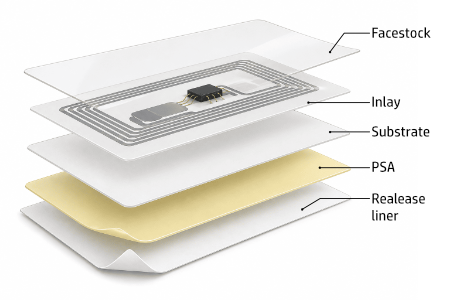
In a finished converted label, the inlay sits between the facestock (top printed layer) and the substrate (backing). Beneath the substrate, two additional layers complete the construction: the PSA adhesive, which bonds the label to its surface, and the release liner — the silicone-coated protective sheet that peels away at the point of application.
Passive, Active and Semi-Active RFID Tags
There are three main RFID tag families, differentiated by their power source:
| Type | Power source | Tead range | Typical applications |
| Passive | None | A few cm up to 12 m | Logistics, retail, documents |
| Semi-active | Battery (assist) | Up to 30 m | Asset tracking in harsh environments |
| Active | Integrated battery | Up to 100 m+ | Geolocation, aerospace |
In industry, the vast majority of applications rely on passive UHF tags: no battery, cost-effective to produce at high volumes, and sufficiently capable to cover logistics, automotive and food traceability. Active tags are reserved for contexts requiring very long read range or mission-critical asset tracking
How Does an RFID Label Work?
The Radio Frequency Communication Principle
A passive RFID system operates on the principle of modulated backscatter. Here is the complete cycle in four steps:
- Emission: the reader continuously broadcasts a radio signal through its antenna.
- Power harvesting: when the RFID label enters the electromagnetic field, it captures that signal and draws energy from it — with no battery required.
- Response: the chip processes the query and modulates the return signal, embedding the stored data (unique identifier, batch number, date, etc.).
- Data capture: the reader captures the reflected signal and forwards it to the management software (WMS, ERP, MES) for processing.
The Decisive Advantage: No Line of Sight
Where a barcode scanner requires the operator to precisely align a laser beam on the printed code, RFID operates blindly. The label can be inside a carton, beneath a pallet, or on a metal part oriented in any direction — the reader identifies it regardless. This property fundamentally transforms end-of-line control and goods-receipt operations.
Simultaneous Reading: Anti-Collision
A UHF RFID reader can process several hundred tags per second using anti-collision algorithms. In a warehouse, this means a full zone inventory can be completed in minutes, where the same task would take hours with manually scanned barcodes. For manufacturers managing large SKU counts, the return on investment is generally achieved in under 18 months.
Read Range: What Influences Performance
Furthermore, the effective read range of an RFID label depends on several cumulative parameters: the frequency used, reader output power, inlay antenna size, and above all the physical environment. Liquids absorb radio waves; metal reflects them and creates interference — two major constraints in industrial settings that require purpose-engineered inlays and substrates.
RFID Frequency Bands
The choice of frequency directly conditions read range, read speed, behaviour near metal and liquids, and compatibility with international standards. There is no universally superior frequency — each band addresses specific application requirements.
| Band | Frequency | Range | Read speed | Industrial use cases |
| LF | 125–134 kHz | < 0.5 m | Low | Access control, anmal ID, heavy industry |
| HF / NFC | 13.56 MHz | < 1 m | Medium | Medical, payment, smart packaging |
| UHF | 860 – 960 MHz | 1 to 12 m | High | Logistics, automotive, supply chain* |
| Microwave | 2.4 GHz | Up to 100 m | Very high | Toll systems, long-range tracking |
* UHF: the industrial standard
UHF (860–960 MHz) has established itself as the dominant protocol in industrial automation. The EPC Class 1 Gen 2 standard (ISO 18000-63) ensures interoperability across equipment from different manufacturers. UHF is the recommended frequency for any new logistics, automotive or supply chain deployment at scale.
RFID Label Types by Application
Flexible Labels (Inlay on PET / Paper Facestock)
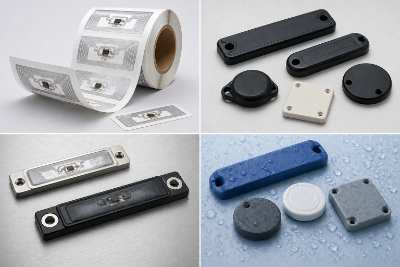
This is the most widely used format in high-volume industrial production. The inlay is sandwiched between a PET or paper facestock and an adhesive layer. These labels can be printed — barcodes, QR codes, variable text, logos — using flexography or screen printing, and die-cut to the exact required shape. They are suited to the majority of logistics and product identification applications.
Rigid Tags (ABS, PEEK, Epoxy Enclosures)
For harsh environments — high temperatures, mechanical vibration, impact, or aggressive chemicals — the inlay is encapsulated in a hard housing. These tags are designed to survive industrial wash cycles, temperatures above 150°C, or full immersion. They are reusable, which justifies their higher unit cost in long-lifecycle applications.
On-Metal RFID Labels
RFID and metal surfaces do not naturally coexist: metallic surfaces reflect radio waves and can null out the inlay signal. On-metal labels integrate an isolating substrate layer — foam, ferrite, or absorbing material — that decouples the inlay from the metal surface and maintains read performance. These are indispensable in automotive, aerospace and industrial tooling management.
Washable and Chemically Resistant Labels
In medical applications (autoclave sterilisation at 134°C), industrial catering (high-pressure washing) or chemical processing, the RFID label must withstand extreme stresses. In these cases, the selection of facestock (polypropylene, reinforced PET), adhesive (high-temperature acrylic) and inlay encapsulation becomes critical. With our expertise in pressure-sensitive adhesive materials and our sector-specific certifications, we are particularly well positioned on these high-value niche applications.
Industrial Applications by Sector
Automotive: Part-Level Traceability from Production to Delivery
The automotive sector is one of the largest adopters of industrial RFID. Every component — body panel, engine, wiring harness — can be tagged from the point of manufacture. That tag then follows the part through the entire assembly process: it triggers transformation operations, records quality control checkpoints, and enables bidirectional traceability in the event of a recall. ATE’s IATF 16949 certification is the prerequisite for operating within this demanding value chain.
Medical: Sterilisation Cycles, Device Tracking and MDR Compliance
Healthcare facilities must track reusable medical devices — surgical instruments, sterilisation trays — with absolute precision: sterilisation cycle count, last use date, number of autoclave passes. A sterilisation-resistant RFID label (134°C saturated steam) replaces unreliable paper-based systems and automates inventory management in the operating theatre. The MDR 2017/745 regulation is currently driving many facilities to adopt this technology.
Logistics & Supply Chain: Automated Inventory at Scale
RFID has transformed warehouse management. Read portals installed at dock doors automatically capture every stock movement. An inventory that previously required a full day of manual operations can now be completed in under an hour, with accuracy rates exceeding 99%. Integration with ERP systems (SAP, Oracle) and WMS platforms enables real-time stock visibility, reducing both stockouts and overstock situations.
Electronics: Component Authentication and Anti-Counterfeiting
In the electronics industry, miniaturised RFID inlays enable the identification of very small components. RFID is also deployed to combat the counterfeiting of critical parts: the chip stores a cryptographic authentication key that cannot be replicated, guaranteeing the origin and authenticity of the component throughout the supply chain.
Food & Beverage: Cold Chain Monitoring and Batch Traceability
EU Regulation 178/2002 mandates full traceability of food products from raw material to consumer. RFID automates this traceability at every stage — goods receipt, processing, storage, dispatch — with precise timestamping. Certain chip variants even support environmental data logging (temperature) for cold chain monitoring, a critical requirement for fresh and frozen products.
RFID vs Barcode vs Data Matrix: How to Choose?
These three identification technologies address different needs. Before investing in an RFID infrastructure, it is essential to understand their respective advantages and limitations.
| Criteria | RFID | Barcode | Data Matrix |
| Contactless reading | Yes | No | No |
| Simultaneous multi-tag reading | Yes | No | No |
| Data rewrite capability | Yes (chip-dependent) | No | No |
| Performance in harsh environments | Excellent | Moderate | Good |
| Cost per unit | Higher | Very low | Very low |
| Line of sight required | No | Yes | Yes |
| Data density | High | Limited | High |
| Best suited for | Dynamic traceability, high volume | Simple identification | Technical parts, permanent marking |
RFID is the right choice when traceability is dynamic, automated and high-volume. Barcodes remain relevant for simple, low-cost identification needs. Data Matrix excels on technical parts where direct permanent marking (laser engraving) is required. In many industrial projects, all three technologies coexist — for example, a Data Matrix engraved directly on the part, with an RFID label on the containing pallet.
We also produce Data Matrix labels and multi-technology identification carriers combining RFID and barcode on a single label — for customers who require read redundancy or a phased transition to full RFID deployment.
How Are RFID Labels Manufactured at High Volume?
Manufacturing an RFID label is a multi-step process that brings together expertise in electronics, adhesive chemistry and industrial printing. Here are the main stages:
1. The Inlay: The Most Critical Component
First, the microchip (IC) is bonded — by thermocompression or conductive adhesive — to the antenna, which is itself etched or printed on a PET film. This is the most delicate step: a defective chip-to-antenna connection, invisible to the naked eye, produces a silent tag. As a result, every inlay is individually tested on the production line. ATE integrates inlays from selected partners, matched to the specific requirements of each sector and application.
2. Laminating: Inlay + Facestock + Adhesive
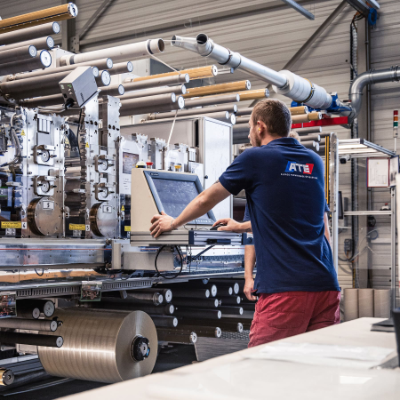
The inlay is then integrated into a multilayer construction: upper protective facestock, inlay, lower substrate with PSA adhesive and silicone release liner. This laminating step is a core process at ATE, carried out on dedicated converting lines. Moreover, the facestock and adhesive combination is selected based on the application’s end-use constraints: substrate surface type (metal, plastic, glass), operating conditions (temperature, humidity, UV) and required service life.
3. Printing: Variable Data, Codes and Graphics
An RFID label is not purely electronic — it also carries a visual message. Flexographic printing is used for high-volume runs with colour backgrounds, pictograms and fixed information; screen printing for technical inks (chemical-resistant, conductive); digital printing for variable data such as sequential numbering, QR codes and Data Matrix. In short, we operate all three processes across our converting lines.
What to Define Before Ordering Your RFID Labels
A successful RFID label project starts with a precise specification. Here are the 7 parameters to validate before any quote request:
- Frequency: LF, HF/NFC or UHF? (In 80% of industrial cases: UHF)
- Application surface: material (metal, plastic, glass, fabric), flatness, surface condition
- Operating environment: temperature range, chemical exposure, humidity, UV, sterilisation requirements
- Required read range: a few centimetres (HF/NFC) or several metres (UHF)?
- Annual volume: high-volume production (> 50,000 units/year) justifies a dedicated die-cut tool and significantly reduces unit cost
- Encoding: do chips need to be pre-encoded at the factory (EPC, customer-specific data)?
- Variable printing: sequential numbering, barcodes, QR codes or Data Matrix to be integrated on the label?
Conclusion
An RFID label is not a simple smart sticker: it is an identification system in which every component — inlay, substrate, adhesive, frequency, encoding — must be selected in line with the real constraints of the application. When properly designed, it becomes an operational performance tool that transforms traceability, reduces errors and automates processes that are otherwise labour-intensive.
We support our customers from specification through to high-volume production, integrating every step of the process: inlay selection, laminating, printing and precision rotary die-cutting. Furthermore, our IATF 16949 certification and ISO 7 cleanroom guarantee a quality level matched to the most demanding sectors.
Do you have an RFID label project?