In industrial environments, a label that fades, peels, or becomes unreadable is more than a cosmetic issue — it can trigger a traceability breakdown, a regulatory non-compliance, or a production stoppage. Selecting the right industrial printing process is therefore a strategic decision. Among the most widely used technologies, flexography and screen printing serve distinctly different purposes. Here’s how to make an informed choice.
Quick comparison: Flexography vs. Screen Printing
| Criterion | Flexography | Screen printing |
| Production volume | High | Low to medium |
| Label durability | Moderate | Excellent |
| Chemical resistance | Limited | Excellent |
| High-temperature resistance | Variable | Very good |
| Abrasion resistance | Moderate | Strong |
| Long-term legibility | Good | Excellent |
| Cost at high volumes | Optimized | Higher |
| Harsh industrial environments | Standard | Purpose-built |
Why the printing process is a strategic decision
In industry, labels are not mere information carriers. They ensure product identification, traceability throughout the supply chain, and regulatory compliance across demanding sectors such as mobility, healthcare, and food processing.
Exposed to severe conditions — moisture, heat, chemicals, abrasion, and mechanical vibrations — industrial labels must hold up over time. An unsuitable printing process can lead to premature degradation, unreadable barcodes, or complete marking failure.
⚠ Important: printing defects are not always immediately visible. They typically surface during production, at quality inspection, or at the end customer — generating significant indirect costs: returns, rework, non-conformances, and line stoppages.
Flexography: efficiency at scale
How it works
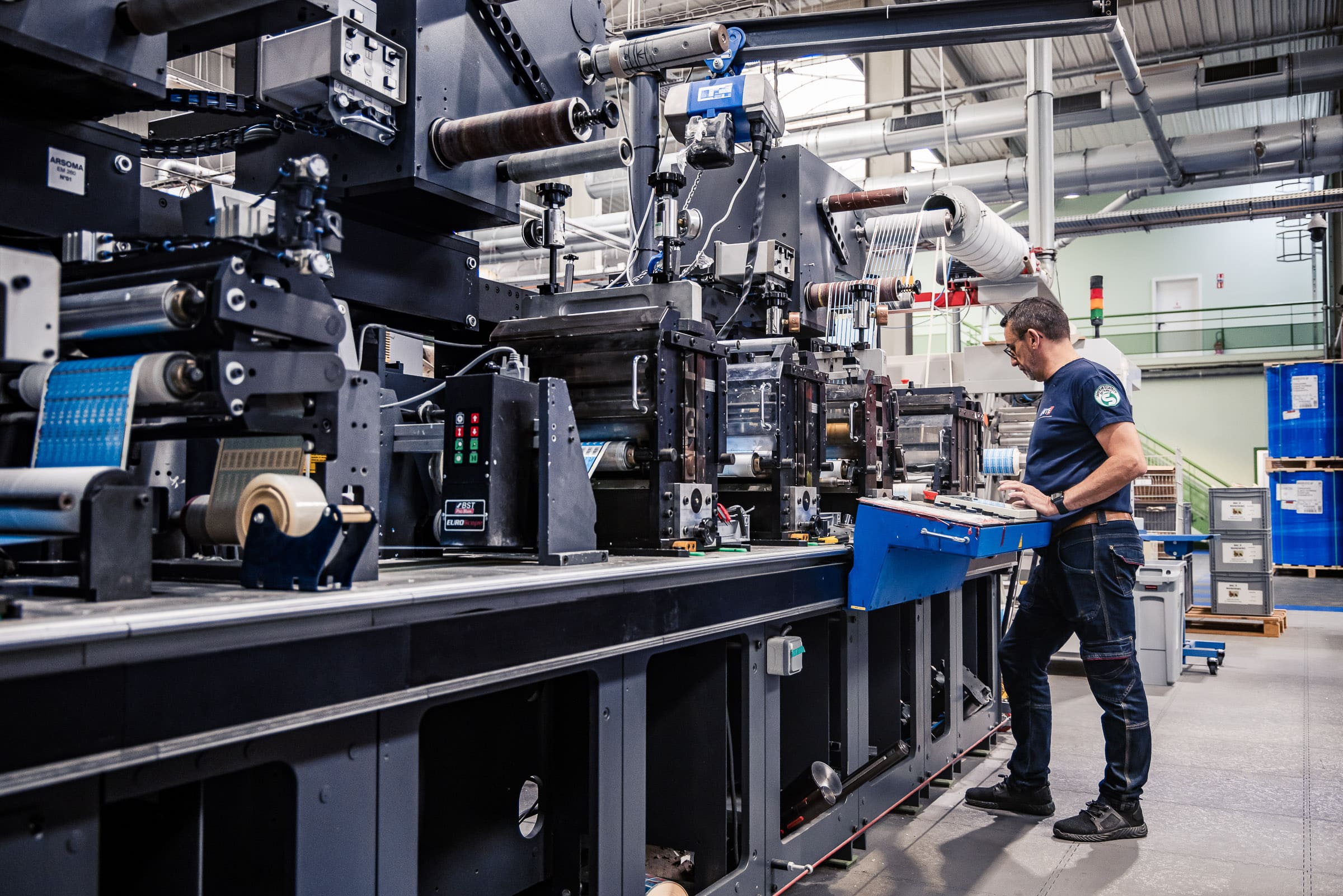
Flexography is a rotary printing process using flexible relief plates and fast-drying inks. Designed for high throughput, it is widely used for high-volume industrial label production.
Strengths
- High throughput and optimized production runs
- Consistent print quality across long runs
- Competitive unit costs at scale
- Well-suited to stable, controlled industrial environments
Limitations
In demanding industrial environments, flexography can show its limits. Depending on the inks and substrates used, chemical resistance, high-temperature performance, and long-term abrasion resistance may prove insufficient over time.
Screen printing : durability for extreme conditions
How it works
Industrial screen printing works by depositing a thick ink layer through a mesh screen. This ink deposit thickness is precisely what gives screen-printed labels their exceptional resistance.
Strengths
- Excellent chemical resistance (solvents, oils, acids)
- Superior high-temperature performance
- Strong resistance to abrasion and mechanical friction
- Long-term barcode and QR code legibility
- Reference solution for regulated environments
Limitations
Screen printing offers lower throughput and higher unit costs at high volumes. It is reserved for applications where durability clearly takes precedence over output.
How to choose between flexography and screen printing ?
The right choice always depends on the label’s actual end-use environment. Here is a simplified decision guide:
→ Choose FLEXOGRAPHY if:
- High-volume production runs
- Stable, controlled environment
- Cost efficiency driven by volume
- Short to medium label service life
→ Choose SCREEN PRINTING if:
- Exposure to solvents, oils, or acids
- High-temperature environment
- Mechanical abrasion or intensive cleaning
- Long-term durability and legibility requirements
Industrial labelling : an underestimated risk
In many industrial companies, labeling is still treated as a technical detail or a cost to minimize. This is a strategic mistake.
Labeling failure — whether from ink fade, unreadable barcodes, or label delamination — directly impacts:
- Industrial traceability and regulatory compliance
- Perceived quality at the end customer
- Production continuity and efficiency
- Brand reputation in demanding markets
The ATE approach : matching the process to your actual needs
At Alsace Techniques Étiquetage (ATE), our philosophy is to “bridge the gap in the world of converting by adapting the machine to the product — never the other way around.” This principle applies equally to the choice of printing process.
For over 30 years, our teams have supported the most demanding manufacturers in designing custom labels, with full command of the entire value chain: printing, die cutting, and lamination. Certified IATF 16949, ISO 14001, and ISO 45001, and approved as a 3M Preferred Converter, we deliver labeling solutions that are reliable, durable, and compliant.
To learn more about our printing capabilities, visit our dedicated page: Our Printing Techniques.
Explore our solutions for identifying, tracking, and protecting your products in the most demanding environments.
Ready to discuss your industrial labeling project?
Our experts assess your environmental constraints and recommend the best-fit process.
Conclusion
There is no universal answer between flexography and screen printing. The right process always depends on the actual industrial environment, application constraints, volumes, and durability requirements.
One thing is certain: a poor choice of printing process is never inconsequential. It can compromise traceability, generate non-conformances, and halt production — at costs far exceeding the initial investment in fit-for-purpose labeling.
To go further, explore our markets: mobility, healthcare, food processing, and electronics — sectors where labeling quality makes all the difference.