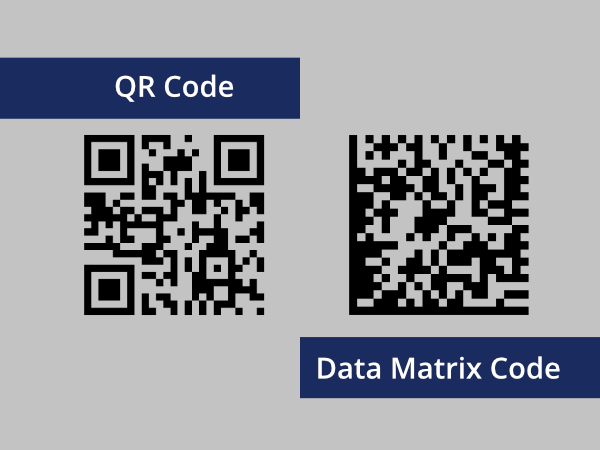
Two 2D barcode formats dominate manufacturing, logistics, healthcare, and marketing: Data Matrix and QR Code. Both encode data in a grid of modules — but their performance, use cases, and tool ecosystems are fundamentally different. This guide covers every key comparison point and helps you choose — or generate — the right format for your specific application.
1. What Is a Data Matrix Code?
A Data Matrix code is a 2D matrix barcode standardized under ISO/IEC 16022. First developed in the 1980s, it encodes up to 2,335 alphanumeric characters in a footprint that can be smaller than 1 mm² — making it the reference format for direct part marking (DPM), pharmaceutical serialization, and medical device traceability.
Data Matrix module size and maximum symbol dimensions
The module is the smallest individual cell in the code. In laser or chemical marking applications, modules can be as small as 0.1 mm. ECC 200 symbols range from 10×10 to 144×144 modules, encoding anywhere from a few characters up to 3,116 digits. Symbol size scales automatically to match the data payload — no manual version selection is needed.
What is GS1 DataMatrix?
GS1 DataMatrix is a Data Matrix code whose content follows the GS1 syntax — meaning any scanner, customs system, or hospital platform can automatically decode what it contains (product reference, lot number, expiry date, serial number) without any prior bilateral agreement. That interoperability is precisely the value of the standard.
It packages multiple GS1 Application Identifiers — GTIN (01), lot number (10), expiry date (17), serial number (21) — in a single symbol. In the U.S., it is mandated under the Drug Supply Chain Security Act (DSCSA) for all prescription drug packaging. In Europe, it is required under EU MDR for medical device UDI marking. Learn more about GS1 standards applied to industrial labeling
Reflectance margin: the key to reliable industrial reading
Reflectance margin is the contrast ratio between dark and light cells in the symbol. On metal, oily, or worn surfaces, a high reflectance margin ensures the code remains readable under degraded industrial conditions — a critical parameter when marking with laser, electrochemical, or dot-peen equipment.
2. What Is a QR Code?
QR Code (Quick Response) was invented in 1994 by Denso Wave, originally for automotive parts tracking. Standardized under ISO/IEC 18004, it encodes up to 4,296 alphanumeric characters and is instantly recognizable by its three corner position detection squares. It is natively readable by all modern smartphones — no app required — which makes it the dominant format for consumer-facing applications.
Static vs dynamic QR Codes: what’s the difference?
This is the most important distinction to understand before generating a QR Code:
| Type | Key Characteristics |
| Static QR Code | Static QR Code Content (URL, text) is encoded directly in the symbol. Cannot be changed once printed. No subscription required — free to generate and use indefinitely. |
| Dynamic QR Code | Dynamic QR Code The code points to a redirect URL. The destination can be updated without reprinting. Enables scan tracking (volume, location, device type). Requires a paid platform subscription. |
| GS1 QR Code | GS1 QR Code Encodes GS1 Application Identifiers (GTIN, lot, expiry). Used in B2B supply chain and increasingly in retail (GS1 Sunrise 2027). Readable by GS1-compatible scanners and apps. |
| vCard QR Code | vCard QR Code Encodes professional contact details (name, phone, email, address). Common on business cards and conference badges. |
| Wi-Fi QR Code | Wi-Fi QR Code Encodes Wi-Fi network credentials for automatic connection on scan — no typing required. |
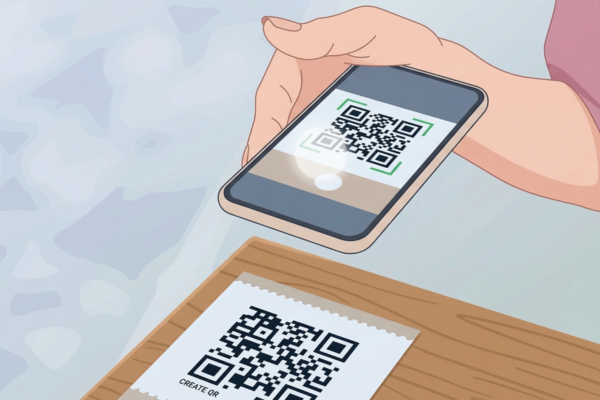
Note: generating dynamic QR Codes typically requires a paid subscription to a platform such as Bitly or Beaconstac. Static QR Codes are always free.
QR Code size, customization, and export formats
Unlike Data Matrix, QR Codes support visual customization thanks to the H-level error correction algorithm (30% redundancy):
- Color: modules can be any color, as long as the contrast between foreground and background meets a minimum ratio of 4:1.
- Embedded logo: a logo or icon can occupy up to 30% of the central area without compromising scannability.
- Export formats: PNG (web), SVG (print/vector), EPS (prepress), PDF.
- Minimum print size: 0.8 in x 0.8 in (approx. 2 cm x 2 cm) for reliable smartphone reading at standard distance. Below this size, use Data Matrix.
- Quiet zone: a white border of at least 4 modules must surround the code on all sides.
Best free QR Code generators online
Several tools let you create a QR Code at no cost and without creating an account:
- QRCode Monkey (qrcode-monkey.com) — advanced customization, logo upload, high-resolution PNG/SVG export. Best free option for branded QR codes.
- QR Code Generator (qr-code-generator.com) — clean interface, basic color customization, fast PNG export.
- Canva — built-in QR code generation within flyer, poster, and business card templates.
- Google Search — type ‘QR code generator’ to access a native tool directly in search results for simple URL encoding.
- Unitag — free tier with color customization; paid plans unlock dynamic QR codes and scan analytics.
Professional platforms for dynamic and high-volume QR Codes
For marketing campaigns, supply chain applications, or large print runs requiring editable content and analytics:
- Bitly — URL shortener with built-in dynamic QR code generation and scan tracking dashboard.
- Beaconstac — purpose-built QR code platform with A/B testing, CRM integrations (Salesforce, HubSpot), and offline scan tracking.
- Flowcode — strong in retail and events, with no-internet-required scan mode.
- BarTender / NiceLabel — for QR Codes on industrial labels or packaging printed at volume via thermal transfer or inkjet.
- Tec-It — GS1 QR Code and industrial-grade generation, REST API available.
In high-volume digital print production, it is possible to generate unique QR Codes continuously — producing a distinct code per unit at press speed. This is standard practice in pharmaceutical serialization, anti-counterfeiting programs, and targeted direct mail campaigns.
→ Learn more about high-volume variable data label printing ([internal link — ATE digital printing page])
3. Data Matrix vs QR Code: Full Comparison Table
| Criteria | Data Matrix | QR Code |
| Standard | ISO/IEC 16022 | ISO/IEC 18004 |
| Max. capacity | 2,335 alphanumeric characters | 4,296 alphanumeric characters |
| Minimum size | < 1 mm² (laser marking) | ≥ 0.8 x 0.8 in / 2 x 2 cm |
| Error correction | ECC 200 (up to 30% | Levels L/M/Q/H (7–30%) |
| Native smartphone reading | No — requires dedicated app | Yes (iOS 11+, Android 8+) |
| Visual customization | No (industrial standard) | Yes (color, logo, shapes) |
| Static / dynamic | Always static | Static or dynamic |
| Primary use case | Industrial, medical, aerospace | Marketing, web, consumer |
| Direct part marking (DPM) | Yes (laser, chemical, dot-peen) | Not suitable |
| GS1 compliant | Yes – required for DSCSA / UDI | Yes – retail (Sunrise 2027) |
| FDA / EU MDR compliant | Yes | No |
| Free generators | Tec-It | QRCode Monkey, Canva, Google |
| Dynamic version available | Not applicable | Yes (Bitly, Beaconstac, QR Code Generator) |
Not sure whether Data Matrix or QR Code is the right choice for your application? Our technical team can assess your requirements and recommend the format that fits your industry constraints and marking process. Talk to an Expert
4. Scanners and Readers: Data Matrix vs QR Code Compatibility
The right scanner depends on the barcode format and the operating environment. The table below maps reader types to format compatibility:
| Reader Type | Data Matrix | QR Code |
| Smartphone – native camera app | No | Yes (iOS 11+, Android 8+) |
| Smartphone – dedicated app | Yes (Scandit, ZXing, Cognex) | Yes (any app or native) |
| 2D handheld scanner (Zebra, Honeywell) | Yes | Yes |
| Fixed industrial reader (Cognex, Keyence) | Yes – incl. DPM on metal | Yes – standard surfaces |
| GS1 / DSCSA – compliant scanner | Yes (GS1 DataMatrix) | Yes (GS1 QR Code) |
| Rugged mobile computer (Zebra TC, Honeywell CT) | Yes | Yes |
| POS terminal / payment reader | Rare | Yes (mobile payment) |
For direct-marked parts on metal or plastic, only readers with integrated lighting — telecentric or low-angle illumination — guarantee reliable Data Matrix reading. QR Code is not suitable for direct part marking applications.
For healthcare environments: handheld scanners such as the Zebra DS2208 or Honeywell Xenon 1950 read both 1D and 2D barcodes including Data Matrix GS1, and are widely deployed in hospital pharmacy dispensing and bedside medication scanning workflows.
5. GS1 DataMatrix and GS1 QR Code: Traceability and Regulatory Compliance
GS1 is an international non-profit organization that defines universal identification standards — the rules that allow any manufacturer, distributor, hospital, or customs system to speak the same language, regardless of country or sector. The GS1 standard assigns Application Identifiers (AIs) that prefix each data element in a barcode, specifying what it represents: (01) = GTIN, (10) = lot number, (17) = expiry date, (21) = serial number.
Both Data Matrix and QR Code can carry GS1 Application Identifiers. The difference lies in regulatory context and sector adoption:
| GS1 Format | Use Cases and Regulatory Context |
| GS1 DataMatrix | GS1 DataMatrix Mandatory for U.S. prescription drug packaging under DSCSA (fully enforced 2023). Required for EU medical device UDI under EU MDR / IVDR. De facto standard in aerospace (ATA Spec 2000) and automotive (AIAG). Requires a dedicated scanner or app — not consumer-readable. |
| GS1 QR Code | GS1 QR Code Being phased into retail under the GS1 Sunrise 2027 initiative — enabling checkout scanners and consumer smartphones to read richer product data (nutrition facts, allergens, batch, expiry) in place of traditional EAN/UPC linear barcodes. Not yet mandated in U.S. pharma or medical device sectors. |
GS1 Sunrise 2027 is a strategic inflection point for CPG brands and retailers: packaging redesigns planned before 2027 should factor in GS1 QR Code readiness to avoid costly reprinting after the transition date.
6. How to Generate a Data Matrix Code
Free online generators
Tec-It (tec-it.com), DataMatrix.me, and Cognex DataMan Tools generate a Data Matrix from any text string or GS1 payload. Export as PNG, SVG, or EPS. Always validate the output with a physical scanner before committing to a print run.
Label software for production-scale printing
BarTender (Seagull Scientific), NiceLabel, and Loftware integrate Data Matrix generation into label printing workflows connected to ERP or MES systems. They handle GS1 Application Identifier sequencing, label templates, and industrial printer drivers (thermal transfer, inkjet, laser).
Developer SDKs and open-source libraries
libdmtx (C/Python), ZXing (Java/Android), and commercial SDKs from Cognex, Honeywell, and Zebra DataWedge allow embedding Data Matrix generation and reading directly into WMS platforms, EHR systems, or custom business applications.
ATE designs and manufactures labels with Data Matrix — including GS1-encoded formats — for industrial, medical, and automotive applications, from short runs to high-volume series, on any substrate. Request a Quote for Data Matrix Labels Contact
7. When to Use Data Matrix vs QR Code
Choose Data Matrix when… Choose QR Code when…
| Choose Data Matrix when… | Choose QR Code when… |
| The part or label surface is very small (< 0.4 in²) | Your end users are consumers with a smartphone |
| Marking must be permanent (laser, chemical, DPM) | You need to embed a URL, social link, or payment flow |
| Your sector requires it by regulation (pharma, medical, aerospace) | You want visual customization — logo, brand colors |
| You work with GS1-serialized identifiers (DSCSA, UDI, AIAG) | You need to update destination content without reprinting (dynamic) |
| The surface is hostile (oil, heat, abrasion, chemicals) | Use case is marketing, events, or consumer-facing |
| Your readers are dedicated industrial or healthcare scanners | Volume is low and free tools are sufficient |
Ready to move forward ? Request a Sample
8. Frequently Asked Questions
What is the difference between Data Matrix and QR Code?
Data Matrix is engineered for industrial and regulated environments: extremely compact, permanently markable on parts and components, and read by dedicated scanners. QR Code is designed for consumer accessibility: natively readable by any smartphone camera without an app, visually customizable, and available in dynamic (editable) versions.
Can you read a Data Matrix code with a smartphone?
Yes — but not with the native camera app. You need a dedicated application such as Scandit, ZXing, or Cognex Mobile Barcode SDK. QR Codes, by contrast, are decoded natively by iPhone (iOS 11+) and Android (8+) cameras without any additional software.
→ Learn more about direct part marking (DPM) capabilities at ATE
What is a dynamic QR Code and do I need one?
A dynamic QR Code points to a redirect URL that can be changed after the code is printed or published. The destination — a landing page, a promotion, a product page — can be updated at any time without reprinting. Dynamic QR Codes also log scan analytics: volume, geographic location, and device type. They require a paid platform subscription (Bitly, Beaconstac, Flowcode). If your content will never change, a free static QR Code is sufficient.
What is the best free QR Code generator?
QRCode Monkey is the most capable free tool for branded QR codes: it supports logo embedding, custom colors, and high-resolution SVG/PNG export at no cost. For GS1 or industrial-grade codes, Tec-It is the most reliable free option. For quick URL encoding, Google’s native search tool is the fastest.
Can a Data Matrix code contain a URL?
Yes — a Data Matrix can encode any text string, including a URL. However, it is not the recommended format for URL use cases targeting consumers, since reading it requires a dedicated app rather than a standard smartphone camera.
What is GS1 Sunrise 2027?
GS1 Sunrise 2027 is a global initiative to make POS checkout systems capable of reading 2D barcodes — primarily GS1 QR Codes — in place of traditional EAN/UPC linear barcodes. It enables richer product data (nutrition, allergens, batch, expiry date) to be accessible to both retailers and consumers directly from the packaging via smartphone scan. Brands planning packaging refreshes before 2027 should factor in GS1 QR Code compatibility.
What is the minimum size for a readable QR Code?
The recommended minimum is 0.8 x 0.8 inches (approximately 2 x 2 cm) for reliable smartphone scanning at a typical reading distance of about 12 inches (30 cm). Below this size — or on complex, non-white surfaces — Data Matrix is the more appropriate format, as its modules can be marked down to 0.1 mm.
How do you verify the print quality of a Data Matrix code?
Data Matrix print quality is assessed under ISO/IEC 15415 (2D printed symbols) using a certified barcode verifier. The instrument measures contrast, reflectance margin, module size uniformity, and error correction performance, assigning a grade from A (highest) to F (non-compliant). A grade of C or above is typically required for industrial and pharmaceutical applications.
Is Data Matrix an open standard?
Yes. Data Matrix is defined by the open ISO/IEC 16022 standard. The libdmtx library is a widely used open-source implementation for generating and reading Data Matrix codes. Commercial SDKs from Cognex, Honeywell, and Zebra offer enterprise-grade performance on top of the same standard.