When an engineering or procurement team looks for a die-cutting or converting partner to work with 3M adhesive materials, the term Preferred Converter frequently appears in specifications and supplier qualification checklists. But what does this accreditation actually cover? What does it mean in practice for part quality, material traceability, or technical support? This article breaks it down and explains why this status is a meaningful selection criterion — not just a badge.
What Is the 3M Preferred Converter Program?
A Global Network of 3M-Vetted Converters
The 3M Preferred Converter program is an accreditation system through which 3M identifies and endorses a network of converting specialists — companies that have demonstrated the technical ability to process 3M materials to the required standards. A converter takes a raw material (roll of adhesive tape, film, foam, membrane) and transforms it into finished parts with precise geometries, through die-cutting, laminating, or a combination of both.
The program operates globally. Accredited converters are listed in an official 3M directory, which procurement and engineering teams can use to identify a qualified partner in their region or for their specific application area.
Accreditation Criteria: Technical Capability, Quality Systems, Service
Earning the Preferred Converter status is not a commercial arrangement. 3M assesses multiple dimensions before granting and renewing the accreditation:
- Technical mastery of converting processes (rotary die-cutting, digital cutting, laser cutting, laminating) as applied to specific 3M material families
- Ability to hold tight dimensional tolerances required by customer specifications
- Quality management maturity: traceability systems, in-process controls, non-conformance handling
- Active technical relationship with 3M teams: ongoing training, access to new product lines, participation in development programs
In short, it is a qualification that covers equipment, know-how, and organization — not just purchasing volume.
What Does It Change for Your Projects?
Direct Access to the Full 3M Materials Range
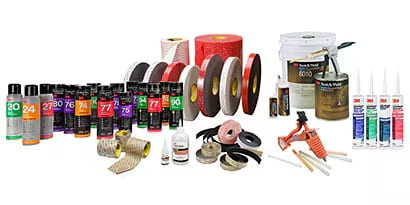
A Preferred Converter has direct access to the complete 3M product portfolio, including less common references and materials still in development. In practice, this means better raw material availability, more predictable lead times, and the ability to work with recent or application-specific adhesive formulations.
For the end customer, this reduces the risk of material shortages or mid-production substitutions — a critical concern in industries where material qualification is lengthy and expensive.
Direct 3M Technical Support: Co-Development and Problem Solving
One of the most tangible benefits of the Preferred Converter status is access to a dedicated technical contact at 3M. When issues arise around adhesion performance, temperature resistance, surface compatibility, or chemical resistance, the converter can engage 3M’s R&D teams to analyze the situation and define the right solution.
This support channel is especially valuable during product development. The converter acts as a technical bridge between the customer and 3M, accelerating validation cycles and reducing the risk of specification errors downstream.
In practice: when a customer brings us a specification involving a critical adhesive interface — sealing joints, bonding on textured surfaces, performance in humid environments — we can co-develop the technical approach with 3M’s engineering teams before the first prototype is even cut.
Guaranteed Material Traceability and Compliance
Working with a Preferred Converter ensures that the 3M materials used in finished parts are genuine, correctly stored, and processed in accordance with the manufacturer’s recommendations. Every material lot is traceable, which simplifies quality audits and regulatory validation files — particularly in the automotive and medical sectors.
This point is often overlooked: purchasing a die-cut part made from 3M tape does not automatically guarantee the properties 3M specifies, if the converter is not accredited and does not follow the recommended processing conditions.
Which Industries Does This Status Impact Most?
Automotive: Tier 1 Requirements and IATF 16949
The automotive sector is arguably where the 3M Preferred Converter status carries the most weight. OEMs and Tier 1 suppliers rely on 3M adhesives across a wide range of applications: trim bonding, wire harness assembly, masking, sealing, vibration damping. Specifications routinely require full material traceability and second- and third-tier supplier qualification.
Sourcing from a certified 3M converter simplifies supplier qualification audits and fits naturally into an IATF 16949-compliant supply chain — the industry’s reference quality standard.
Electronics and Medical: Where Adhesive Interfaces Are Critical
In electronics, 3M adhesives are used in applications where dimensional accuracy and property consistency — thermal conductivity, electrical insulation, resistance to thermal cycling — are non-negotiable. A poorly converted part can generate defects that are invisible at assembly but critical in service.
In the medical sector, the same logic applies, with the additional requirements of biocompatibility and regulatory documentation. The Preferred Converter status, combined with other sector-specific certifications, strengthens the supplier file during FDA or CE audits.
What Your Procurement and R&D Teams Gain
For procurement teams, the Preferred Converter status simplifies supplier qualification: a significant portion of the verification work has already been carried out by 3M. For R&D and industrialization teams, it means a partner who can contribute technically from the design phase — not just deliver parts to a drawing.
ATE as a 3M Preferred Converter: What It Means in Practice
A Technical Relationship, Not Just a Commercial One
ATE is an accredited 3M Preferred Converter. This accreditation reflects a long-term working relationship with 3M’s teams: training on new product lines, participation in development programs, and hands-on feedback on how materials behave in production.
For ATE, this status is not a standalone marketing claim. It is consistent with the broader quality positioning of the company: IATF 16949 certification, Tier 1 supplier status within the Renault-Nissan-Mitsubishi Alliance, and UL certification.
In-House Rotary Tooling as a Precision Advantage
The precision with which 3M adhesive materials are converted depends heavily on the quality of the tooling used. ATE holds a capability : through its subsidiary Rototechnix, it manufactures its own rotary die-cutting tools in-house.
This in-house tooling capability ensures tight dimensional tolerances on converted parts, extended tool life, and the ability to rapidly adjust part geometry — without depending on an external toolmaker. For customers working with technical 3M adhesives, it is an additional guarantee of quality consistency in series production.
Concrete Application Examples
Among the recurring applications ATE handles using 3M materials:
- Adhesive foams and gaskets for the automotive sector (bonding, sealing, vibration management)
- Adhesive films for electronic component assembly
- High-temperature masking tapes for industrial painting processes
- Multi-material parts combining a 3M adhesive with a specific substrate (laminating)
In each of these cases, the Preferred Converter status ensures that the 3M material is processed according to the manufacturer’s recommended conditions — and that traceability is maintained from the raw roll to the finished part.
How to Select a Certified 3M Converter
Start with the Official 3M Directory
3M maintains an online directory of Preferred Converters, accessible through the official 3M website. The directory can be filtered by country, industry, and material type. It is the first step to verify that a supplier is genuinely accredited — rather than simply a 3M product distributor.
The distinction matters: a distributor can sell rolls of 3M tape, but may not have the equipment, the processing expertise, or the technical relationship with 3M that the Preferred Converter status implies.
Questions Worth Asking
To assess a 3M converter beyond the accreditation status alone, here are the right questions to raise in a first conversation:
- How long have you held the 3M Preferred Converter accreditation?
- Which 3M material families do you work with most frequently?
- Do you have a dedicated technical contact at 3M?
- What is your rapid prototyping capability for non-standard 3M adhesives?
- Can you provide lot-level material traceability documentation for production runs?
The answers will help distinguish a converter genuinely embedded in the 3M ecosystem from one where the accreditation is primarily formal.
Take It Further
ATE’s team is available to review your adhesive converting requirements and support you from prototyping through to series production.